Showing posts with label writing. Show all posts

Thursday, July 18, 2013

Driving Me Crazy

Steve McQueen in Bullitt

I can remember first learning to drive, slipping behind the wheel of my dad's sleek, new, charcoal gray Camaro Z28 with its T-tops and fat tires. It was a fast car and I'm pretty sure my little sisters were both in the backseat for that inaugural drive. I can't remember where I drove or for how long that first time. I only remember one thing: it was fast.

I remember being taught to ride a two-wheel bike. It was on the grounds of the Skinner Center at the corner of Central and Tanglewood in Midtown Memphis. We lived in the house across the street, on the opposite corner of that intersection. I don't remember the make of the bike, but there was plenty of high, chopper-style handlebar. And I'm pretty sure the tires were solid rubber.

My oldest son learning to ride a bike set a precedent - he taught himself. Neither of us had the patience for the lessons, we quickly learned. From that point forward, both JP and S have been self-taught on two wheels. GK is still a question mark on that rite of passage.

So far, C has been an eager learner and patient pupil behind the wheel of a car. And I've been uncharacteristically patient myself. We're older, I guess, and there's a lot more at stake. It's still not finished, still five months from his 16th birthday, and he's yet to take a vehicle out on city streets. But in an empty parking lot, he's as smooth a driver as Steve McQueen or Morgan Freeman.

Here's to many more calm lessons, and to many years of safe driving by all of my kids. And here's to the memories such milestones make.

Today's "Because I Said So" column in The Commercial Appeal:

If son's still driving in 30 years, he passed test 
I recently drove my 15-year-old son to a wide open parking lot, parked the car and handed him the keys. It was his first time behind the wheel of a car and my first time in the passenger seat with a teenager behind the wheel of a car since I was a teenager myself. I dialed 911 and let my thumb hover over the send button. 
He did pretty well, though, narrowly avoiding the few obstacles, and I only barked “Brake!” once or twice. 
I learned how to drive through a combined effort of my father and his midlife Camaro Z28 and Memphis City Schools. Despite your experiences on the streets of Memphis, many of us drivers had lessons. And how many Memphians my age were taught to drive by Mr. Rafael? 
After a three-week course of textbook and on-the-road tutelage, Mr. Rafael administered our final exam, a grueling, hourslong written and multiple choice test as I recall, only to tell us when we were finished to hold on to that test and if we were alive to read it in 30 years, then we passed. 
I’ve passed. And here I am trying to pass that knowledge on to my own son. Imploring him to check his mirrors, mind the blind spots and pump the brake pedal. 
When he was 6, I drove him to a wide open field at Tobey Park to teach him to ride a bicycle. It took only about 15 minutes before we were out of patience with each other and I loaded up the bike in the back of my truck and we drove home in silence. It wasn’t long after that when I was down the block talking to a neighbor, and here came Calvin, riding his bike as though he’d been doing so for years — self-taught. 
How much simpler would it be if they were able to teach themselves to drive a car? How much better would it be for our nerves if we could just send our teenagers away and have them return as safe and responsible drivers? 
I told him that day a couple of weeks ago, as we made circle after circle in the vacant lot, that it amazes me that just anyone can drive. That we allow anybody who is of age and able to pass a fairly simple test the opportunity to wrap himself in metal and hurl himself down the interstate at 65 mph. And then I told him to “Brake!” 
He’s a good kid, and I have faith that he’ll be a good, conscientious driver. I’m not sure how I’ll be as the parent of a driver, though. I don’t think there are any lessons for that, none that Mr. Rafael imparted anyway. 
I can’t imagine that first time I’ll stand on the porch and wave my son away as he backs out on his own and heads into traffic. I’ll wish him well. And I’ll wish I could give him just one last word of advice: “Brake!”

Friday, July 12, 2013

Something Pretty, Something Beautiful by Eric Barnes

Two things struck me while reading Something Pretty, Something Beautiful by Eric Barnes (Outpost19, 2013). The first thing is the movement. Not necessarily the way the book flows, though it will keep you interested and curious from start to finish. What I’m talking about is that when Barnes writes movement – a car full of teenagers speeding down the highway, kids running and tumbling downhill into a gulch, fighting and fleeing – it is as though I was right there in the melee covered with mud and booze. The action is swift, it’s breathy, sweaty and, quite often, bloody.


Something Pretty, Something Beautiful is the gripping story of four friends in Tacoma, Washington, and jumps around among moments of childhood until they approach the fringes of adulthood. Brian Porter is the narrator, though Will Wilson is the ringleader, a young man who carries violence and mayhem with him like a flask of whiskey. Teddy and Coe round out the foursome which blows in whichever direction Will Wilson commands. Those winds tend towards fights and break-ins and some arson while always, always moving.

The near-constant movement is what the young men engage in to fill the emptiness, to fight off boredom and, maybe, to keep from thinking of the future and what each might want outside of Tacoma. The book takes place in the 1970s, and if it were today they might all be diagnosed with ADHD. In Eric Barnes’s Tacoma of the 70s, however, teens swallowed a pill of recklessness, violence and peer pressure.


The second thing to strike me didn’t come to me until late in the book, until page 230 to be precise. It is that I hate these people. I don’t hate them for the things they do, although their actions on the whole are awful, but for what they don’t do. No one ever steps in to stop another from doing the awful thing. It is this lack of will, the absence of strength to be decent, that makes them so unlikable as people. This isn't to say I don't like the characters because of a flaw in the writing. Quite the opposite. Barnes paints their personalities and actions so well that I think of them as real, as walking and talking people. And I hope to never come across such in the real world.

The book is dark. Understand that. This is no light beach read. Barnes takes all of the anxiety, frustration, angst, anger, sex and violence that might collectively fill a high school full of adolescents and condenses it down into these four characters. He keeps it simmering on a flame until it's a bubbling roux and then he holds our wrist and forces our hand into the molten mass. The book is raw and touches at something we've all felt, whether it's the hope for something better or the frustration that it might never be.

There is nothing pretty or beautiful in this book unless it is that hope that there might be something better beyond the city limits and the lives these boys are destined to lead. The stories and the writing will keep you involved to find out if it's possible, to know if one or all of them pack up a car at last and find what it is that might save them. As readers, all we can hope to do is grip the roof of that car as it approaches dangerous speeds and hold on for dear life.

Eric Barnes grew up in Tacoma and now lives in Memphis where he is the publisher of The Daily News, The Memphis News, The Nashville Ledger and the host of Behind the Headlines on WKNO.

Wednesday, July 10, 2013

The Impossible Lives of Greta Wells: a review

In THE IMPOSSIBLE LIVES OF GRETA WELLS (HarperCollins, 2013), Andrew Sean Greer has once again imagined a world for us to inhabit so well that, by the end of reading, we might be able to say, "I've been there." This time, it is the island of Manhattan spread out among three eras. Greer gives us the character of Greta Wells, a woman who becomes unstuck in time just as Billy Pilgrim in Kurt Vonnegut's SLAUGHTERHOUSE-FIVE or Henry DeTamble in Audrey Niffenegger's THE TIME TRAVELER'S WIFE.

For Greta Wells, however, the times are predetermined. She will travel to either 1918 or 1941 rather than land in an unknown time, uncertain of who she will meet or how to react. In her present life, in 1985, Greta Wells is suffering from depression brought on by a great loss in her family. She's offered a series of treatments by her doctor, a new form of the antiquated procedure of electrotherapy. Something happens, though, and with each jolt of electricity in the series, Greta Wells is sent to another time for a matter of days until the next procedure is administered. For these days spent in the past, she lives the life of that time's Greta Wells. She is the same woman whose life is altered in various ways, as though she's looking into several different mirrors, each with its own altering fissure.

There are issues that speak to the times that face each Greta Wells: epidemics of influenza and the AIDS virus, world wars, the limitations of women in society, Prohibition and politics. THE IMPOSSIBLE LIVES OF GRETA WELLS posits the theory held by physicists and novelists for centuries that we may not live our life on one plane of existence and time. That while we are awakening in our house each morning, making a pot of coffee, checking e-mail, rousing the kids for school, that there is another us in another time living a similar life in his own version of morning. Time is not linear, Greer assumes, but deep. It repeats and folds in upon itself, and while our actions here today have specific consequences, the same actions in another lifetime might have set our lives on an entirely different track. It's a freeing feeling, I think, to know we may have more than one chance at all of this.
 
Above all, though, the novel is the story of relationships and how the issues remain the same regardless of era or circumstance. Though actions may alter the course of a day or a lifetime, the ways in which we regard and interact with family, friends and lovers are ever present. While Greta Wells bounces from decade to decade and comes to know husbands, aunts, children and lovers from the past, there is no relationship more prevalent than that between her and her twin brother Felix. It is their bond that acts as balast and holds her fast to each time period in which she finds herself. Her determination to hold on to him, to make life better for him and protect him, causes her to question her very place in history.

I found the construction of this book to be a surprise. I'd expected it to be more like Niffenegger's tale with the protagonist flying through time, never knowing just where she might land. Greer's book allows more structure for Greta Wells, and us, by knowing where she's heading. I wasn't disappointed. Quite the opposite, in fact, as reading the novel helped me to better see a way to build a manuscript I'm currently working on (thank you for that!). 

I do wonder why Greer chose the specific times he did, though. The onslaught of AIDS in the 1980s plays heavily into the story and is juxtaposed with an influenza outbreak in 1918, as well as the ending of World War I. The jump to 1941, of course, coincides with the ramping up to America's involvement in World War II. But there are events throughout the 20th century that would have worked as well. This isn't a criticism, but a curiosity. While reading, I imagined Greer sitting at a desk with three calendars opened before him, each to a different year, and he would move back and forth to write what was happening in a particular month of any particular year.

By the end, the Greta Wells we are first introduced to, a woman made small and helpless in grief, is in control of her destiny and has choices to make that will resonate through her life, the lives of those close to her, and history itself. To make such a decision, she calls upon wisdom gained from every plane of her life, from every life lived. Her life may seem impossible to her at times, but time is only an obstacle to be overcome. Once she's made her choice, the pieces seem to fall into place.

Other novels by Andrew Sean Greer:

The Path of Minor Planets (my review)
The Confessions of Max Tivoli
The Story of a Marriage (my review)

Thursday, June 27, 2013

Following Richard Brautigan and Corey Mesler

This is a work of fiction.
Any resemblance to persons living or dead or in-between is coincidence. Even those folks you think are real are as phony as music mingling within a dream.
-- Copyright page of the novel FOLLOWING RICHARD BRAUTIGAN

My confession is that I had no idea who Richard Brautigan was. Indeed, even as I read the novel FOLLOWING RICHARD BRAUTIGAN by Corey Mesler (2010; Livingston Press, The University of
West Alabama), I had no idea if his character was an actual person or a fabrication of Mesler's rich mind. Neither did I search to find out the truth (or untruth) as I read, but relished, instead, the image presented on the page. It wasn't until just now, when I looked him up on Goodreads and Wikipedia, do I see that Richard Brautigan was an actual living, breathing and writing man. Who knew?

Corey Mesler knew and has incorporated fact with fiction into a novel that carries the reader from Oklahoma City to San Francisco and back again. It's a road book and I love a road book. Mesler breaks up his story into tiny little chapters as though we're driving down the highway and stopping every once in a while to look over the edge of a cliff into the bluest ocean or to snap a picture of a reddish butte at sunset or to eat some mushrooms. Mesler tale is constructed in a way some of us may not be able to get away with and each tiny little chapter has its own heading. It seems appropriate, though, as the protagonist, Jack Morton, is a romantic and adventurer, and everything a romantic and adventurer does will (and should) inevitably have its own heading.

Would-be writer Jack Morton travels to San Francisco in an attempt to find his hero, Richard Brautigan, not knowing for sure if the man is dead or alive (he's dead, both Mesler and Wikipedia say). He doesn't locate his traveler, of course, yet does find a young woman, another treasure of a sort. His heart is broken, as is also endemic of romantics and adventurers, though it is mended by a visit from the ghost of Richard Brautigan who leads his protegé on another cross-country trip. This trek is full of strange places and even stranger people and Jack Morton becomes close to the beat icon while remaining physically distant, separated by mortality and one car length.

In the end, Jack Morton seems to find what he needs. He takes something from the counsel of Richard Brautigan and from the journey itself that helps him to repair his heart and find what it is within himself to go on writing.

Mesler's relationship with the pop culture of the 1960s and '70s is an intimiate one, yet the bits and pieces of music, fashion, film, literature and politics don't come across as mere props. He has a talent for putting it all in a context that makes it seem as natural as a well-researched prop in a movie or television show. It adds to the story rather than overshadowing it. It's a magic trick and Mesler is an adept magician.

(I don't know what Mesler's process is for writing, but I imagine him in a darkened room with three separate desks. On each desk sits a psychedelic-colored typewriter and in each typewriter is a sheet of yellow paper and on those sheets of yellow paper is a poem, short story or novel in progress. In my imagining, he types at one until an egg timer in his mind dings and he moves to the next. For twelve hours a day he does this and, once finished, he watches a movie with his daughter. It's a Fellini movie. As each poem, short story or novel is finished, of course, it is published. At the end of Corey Mesler's typewritten journey is our own treasure, dear reader. Now go and find it.)

Thursday, June 13, 2013

The Path of Minor Planets

THE PATH OF MINOR PLANETS (Picador, 2001) by Andrew Sean Greer is a book about time. It's the story of how people might go away and then come back, how they change or how very little they change over that time.

The book opens in 1965 on the small island of Bukit in the South China Sea where a group of astronomers has gathered to witness the return of Comet Swift and the meteor shower it promises to bring with it. There are Eli and Kathy Spivak, Denise Lanham, Dr. Manday, Professor Jorgeson, Dr. Martin Swift, the discoverer of the comet twelve years earlier, and his 5-year-old daughter, Lydia. The occasion for this gathering is near perihelion, that moment when an object comes closest to the Sun. The mood is light, the tropical air is hot and bodies, the Earthly sort, move closer to each other in their own, needy perihelion. When the meteors become visible, the scientists take up their posts with excited shouts of "Time!" echoing from the observation deck of the sultan's castle high above the beach as they attempt a precise record of the shower. But when things change, when a small boy falls from the deck to his death far below, there is no record and everyone's lives, like the comet as it comes in contact with a larger celestial object, causing it to waver and wobble, will find their own orbits altered.

The second part of the book takes place in 1971, and a party at Swift's farmhouse to celebrate Comet Swift's near aphelion, the point at which an object is furthest from the Sun. It's a time of uncertainty, the comet possibly lost in space forever, a fact which won't be known for some time. The characters, six years older now, have changed and there is an air of uncertainty in many of their lives as well. They've grown, they've parted ways or had affairs or fallen in love. There is some talk of the boy who died on Bukit, but even exactly what happened that night is uncertain.

The story goes on this way, leapfrogging through the years, six years at a time, as the comet approaches and then recedes from Earth. It's a wonderful way to frame a story and Greer is adept at weaving his language from the scientific to the poetic. The relationships of the characters with each other come and go like the comet, and they are at just as much risk of exploding or fading away. There is loss and death and near misses. In the span of time, from 1965 to 1990, there are children born, friendships ended and rekindled, secrets found out and others kept for eternity.

I read THE PATH OF MINOR PLANETS while on vacation at the beach with an expanse of blue sky as a backdrop during the day and an untold number of stars against the black night. I absolutely love this book. Greer's storytelling is powerful enough to make us look to the sky and wonder at what might be there and to look within ourselves to see what it is we're made of.

(Andrew Sean Greer's new novel, THE IMPOSSIBLE LIVES OF GRETA WELLS, comes out June 25, 2013. I'm a big fan and have enjoyed previous novels THE CONFESSIONS OF MAX TIVOLI and THE STORY OF A MARRIAGE. If you haven't read him, treat yourself today.)

Monday, May 13, 2013

Reunion by Alan Lightman

A reunion is a coming together, a reuniting of like minds that have shared like experiences. At the core of REUNION (2003, Pantheon Books) by Memphis's own Alan Lightman, however, is detachment. In the opening scene, Charles, a small-college professor, is lying post-coitus with a woman and wishing he was someplace else. "I fly above mountains, dizzy, frightened," Lightman writes. Charles is there, but he isn't, in this house that once belonged to an ex-wife who left it to him. It is his, but it isn't. On televsion, Charles and Sheila watch news footage of a devastating Honduran earthquake and, even as Sheila says she will donate money and urges him to, as well, he has trouble mustering sympathy for something so far away. "The truth is, I feel no connection to the faces on the screen. The Hondurans
are just so many electronic pixels."

Charles attends his twentieth college reunion alone and wanders the campus as though it is all new to him. He talks with classmates who he has no real affection for, and then he begins to recall an episode from his college days with intense clarity. It was during that time that he met the great love of his life, Juliana, studying to be a ballet dancer. The bulk of the book is spent in flashback, which switches from the opening first-person narrative to third-person. The protagonist is Charles, but it isn't.

Juliana lives and works in New York City, a two-hour bus ride for Charles; another instance of detachment. He becomes obsessed with her, wanting to be with her at all times and thinking only of her as he sits through biology and poetry classes. The time is the 1960s and, even as the names of classmates are added to a list of the dead in Vietnam, Charles feels no connection to this war or its protesters that he is of age to join. Juliana, too, is aloof. She tells him she loves him, but not as much as he says so. Much of their time together is spent with him watching her practice and then watching her work at a small diner where she waits tables. He is with her, but not.

When Charles suspects Juliana has found another lover, he becomes paranoid and obsessed with the idea. He has the heart of a poet and we see it flayed open, his agony at their distance and his not being able to have her in the way he wants as raw as an exposed nerve. There is risk in such obsession and Charles learns what the penalty is, still feeling it as though touching a hot stove even after more than twenty years.

Throughout the story, we are brought back to the first-person and the present where Charles picks among the shadows of the campus where all of this first happened, but it is obvious that his mind is not in the moment. He is here, but he isn't. His time and experience with Juliana shaped him in the way that we're all shaped by first loves, and first heartbreaks. Lightman is a trained physicist, a scientist, yet he, too, has the heart of a poet.

Friday, May 10, 2013

Because I Said So: I want a second chance to be a band geek

I like that geeks have taken that word - geek - and empowered it. It has come to be synonymous with "aficionado" or "expert" or "enthusiast." It's become a term spoken with pride. Middle and high school students who put all they have into practicing their instruments and honing their skills have everything to be proud of, from the time spent alone in their rooms with a folder of sheet music to the rousing concerts they put on for friends and family.

I didn't realize this when I was a student at Kirby High School. I had friends who were in the band - Chris, Carl, Rich, Jo Lynne, among others - but I thought of it as just another class they took; a foreign language I could never hope to test well in. It wasn't until my oldest son picked up the alto saxophone, later making the switch to baritone sax, and his brother took up the clarinet, that I understood what goes into being in the band. There is class during the day, then practice after school, then practice here at home. There are shows to prepare for, All-West to obsess over, and smaller ensembles playing around town. I was impressed.

At a concert at White Station High School last year, the jazz ensemble played and it was amazing. I'm a jazz fan and it's rare that you get to hear it played live. Even at such a novice level, the music sounded full and the players were having fun. It gave me the idea for a story I pitched to Memphis Magazine on jazz in Memphis which should be in the June 2013 issue.

While researching that story, I came across the story of Manassas High School and its rich tradition. It's where so many artists - Jimmie Lunceford, George Coleman, Charles Lloyd - got their start in music, and middle and high school is where many musicians first pick up an instrument. It's just that important. The school band room, marching field and auditorium are where students find their confidence and their voice, their passions and, for some, a career. They learn teamwork and responsibility, the importance of practice and the rewards of effort.

This week's Because I Said So column champions the geek. I only wish I'd understood more of their language when I was in school.

Wanted: a second chance to be a band geek 
The story was all over my social media feeds last week. The principal of a low-performing school in Roxbury, Mass., let his security staff go to help pay for more arts teachers. It was another of those stories I ignored at the time, knowing that if I found I was interested in reading it later, then it would be there; stories have a way of circling around and coming back to us. And this one did just that as I sat in the audience twice in the past week for my sons’ band concerts at White Station Middle and High Schools. It’s the type of setting where a story on the importance of funding arts programs in schools might be set to the music of Gershwin. 
If you’ve never been to a concert at that level, it is nothing less than extraordinary. I wasn’t in the band in high school. Band geeks, that’s who was in the band. It turns out there is no shame in that. Just the opposite: It’s a moniker worn with pride. There may be no other instance of students working so closely together with their teachers than in a school auditorium as they give a performance everything they’ve got. They all have a stake in it. They’re all trying to make this thing — this arrangement — sound as whole and as perfect as possible. To do such a thing takes more than mere talent: It takes teamwork. 
Many of the professional musicians I know all came to their instruments through their secondary schools’ band programs. How many adults today do you know who can show a direct line from middle school to their careers? The conductors on stage this past week — Mr. Wright, Mr. Guinn and Mr. Scott — are the Pied Pipers of our children, leading them into something that, even if they don’t make a job of it, they will use in some way or other their entire lives. 
In a recent conversation, Dru Davison, performing arts coordinator with Memphis City Schools, hit on the ability of music to facilitate all learning when he spoke of the many jazz ensembles in the schools and the art of improvisation. 
“You can recite someone else’s piece of music, or you can take everything you know about music and create your own, and that kind of creativity and innovation is really what employers are looking for,” Davison told me. “It’s about being college- and career-ready, and if you have kids in a jazz band, you know that they’re showing up on time for every rehearsal or else they can’t perform.” 
That school in Roxbury, Orchard Gardens Elementary, has shown a vast improvement in its test scores, in its morale and in its security issues even without the aid of a police force. They’re working as a team now — students, teachers, administration — to make their arrangement the best that it can be. 
If I had it all to do over again, would I be a band geek? You bet I would. I would be awful, mind you, but I would try my hand at the saxophone or the clarinet or maybe even the tuba. In lieu of talent, I sit in the audience as a music lover. 
I’m a proud parent of public schoolchildren, and I’m with the band.

Wednesday, April 17, 2013

5 Years of Saying So


In the spring of 2008, at a time when I was pulling my hair out over the willfulness of a 2-year-old and with running my own business, I was asked by Stacey Greenberg if I'd like to alternate Thursdays with her writing a column for The Commercial Appeal about what it's like to raise kids in Memphis. I had been writing about my kids on this very blog for two years already so I said, "Sure, why not."

The truth is I might have used an exclamation point or two in my answer. The truth is I never expected "Because I Said So" to last six months, such is the volatile nature of the newspaper industry and the tenuous grasp of any freelancer on any project. Yet here we are, five years later and I'm still given the opportunity to write it, still pulling my hair out over the willfulness of a now-6-year-old. Stacey has moved on so the opposite Thursdays are filled with . . . something, I don't really look at the paper on those days.

It's been a dream job, more than you can imagine. To be able to document the awesome responsibility of raising four children, the fun, the heartache, the fear. Those noises and smells. It's fun when we're stopped out at the grocery store or the bookstore by readers who ask, "Are these the children you write about?" And I answer, "Children? These aren't mine, I don't really have any kids." Oh, my children laugh at this every single time. It's the most minor celebrity anyone could ask for and the kids are always there to bring me back down to my proper level, and then some.

A lot has changed over these five years and hopefully some of it has produced interesting fodder for such a column. A lot more will happen over the next five and I hope I'm here tell you so in this column. We'll see. Thank you to everyone who helped make it possible, to my family for putting up with their foibles, faults and flatulence being spotlighted in the newspaper twice a month, and especially thanks to all of you who read regularly. Thank you for the comments, the letters and e-mails, the remarks in public. It means more to me than you will ever know.

On this fifth anniversary, here is the very first "Because I Said So" column that ran in The Commercial Appeal on April 17, 2008.

Real kids shrink notions of big family 
My grandparents, Bob and Shirley Fachini, raised seven children, a respectable number by anyone's standards. 
It was the 1950s and '60s, a much simpler era, I'm told. Families were larger then because this country needed as many citizens as possible to fight communism, go to Saturday movie matinees for a nickel and colonize the moon. 
They would later come to call these babies "boomers," because of how much noise that many children, at one time, in one place, will make. 
Their house was warm and loving and, sure, it was cramped, but they made do. Bob built a table large enough for everyone to eat around, and Shirley sewed dresses for the girls. 
It sounds like an idyllic time, and the stories of the antics of my aunts and uncles as kids have engaged me since I was a child. 
It was those stories that had me wanting a large family of my own. 
My wife, Kristy, and I have four children between the ages of 21 months and 10 years. And, as it turns out, we're done. 
That's right. I don't know what got into my grandparents' brains to make them think seven kids was a good idea, but I'm afraid something had to be a little off for two intelligent people to willingly welcome that many little people to live with them. 
By stopping now, we're not squashing my dream of raising a big family, because four is the new seven. 
When Kristy and I tell people, especially new parents with only one child, that we have four, the look we get is generally awe and amazement. 
Never envy. 
Maybe just a hint of pity. Yes, mostly pity, now that I think of it. 
The truth is, we weren't exactly sure at the beginning what we were doing. 
Kristy researched parenting styles, while I was content, and over my head, just keeping the kid alive and somewhat happy. Ten years, and three babies later, it's still all I can do. 
But our home now is full of love. Just as much with love, in fact, as it is with discarded Pop-Tart wrappers, broken and mismatched toys, half-emptied cups of milk and diapers, both clean and dirty. 
Parenthood is an easy enough club to enter, though staying in the good graces of the club's membership board -- your kids -- is tricky. 
Nothing was easy for my grandparents either, yet they signed on for seven kids and dealt with them as they showed up. And if they could handle seven, then four should be cake, right? Or at least a chocolate icing-smeared face smiling up at us. 
We're doing our best with our quartet, in the spirit and with the tenacity of my grandparents. 
We'll send them to the best schools we can, we will communicate openly with them and we'll raise them to be caring and informed citizens, who will one day, hopefully, grow up to colonize the moon.

Monday, March 25, 2013

James Conaway's "Nose"

Way back in 1993, James Conaway published his memoir MEMPHIS AFTERNOONS. Not long after that, he came to Memphis for what was then the River City Writers series of lectures at the University of Memphis. I went to a reading and signing of the book, and we later met for drinks at Old Zinnie's in Midtown. I was writing then, though I never would have said of myself, "I'm a writer." It was all too new for me, I was an unfocused and gangly 23-year-old, still green on the vine. But I wrote every day and I told Jim this and he told me that, if that were the case, then I was already far ahead of many of the graduate students he'd taught. He implored me to continue. I didn't ask him to read anything I'd written and, blessedly, he didn't ask to see any. I can't imagine what I might have been working on then, but know for a fact it would have gone down bitterly, with an aftertaste of youth and angst throughout.

Nose by James Conaway
Jim advised me to go on writing daily and yet I did not. Things happened in the intervening years, movement, a business was bought and sold, kids were born and, for a time, I stopped writing altogether. I lost whatever advantage I may have had by simply putting my pencil down. And then I started back, wrote some short stories, some journalism, a few novel manuscripts, and seventeen years later I would find myself sitting across the table from the novelist Richard Bausch. Over copious glasses of wine, coincidentally, he would bolster the idea in me that a writer must write every day. "Do the work," he would say, and he would also tell me and my fellow Moss workshoppers that the goal was to make it all seem effortless. He said, paraphrasing, to write it and rewrite it and work at it until the reader doesn't even realize he's reading.

I've just finished reading Conaway's latest novel, NOSE (Thomas Dunne Books), and it is effortless. The sense I had while reading it was that I was sitting down with the author in a comfortable bar, sipping wine, and listening to a story being told. The story in this case is of a valley in Northern California where wine, and the subsequent effluvia, is the main cash crop with players going back generations or, in some cases, only days. Les Breeden tumbles into town on a Pacific breeze to work at the area's small newspaper, only to be laid off before that breeze has ceased to blow. He meets some regulars in a bar called the Glass Act and becomes entangled with the wife of Clyde Craven-Jones, the preeminent wine critic. Craven-Jones – CJ, as he's known – has had a mystery bottle of Cabernet left on his doorstep that garners his highest rating. But who left it there? No one comes forward and the hunt for the mystery vintner leads us through a valley peopled by farmers, high society, drunks, scientists, capitalists and immigrants; oenophiles all, their veins flowing with the thick, fruity stuff.

Conaway is knowledgeable in wines and how they come to be, there's no disputing that. His nonfiction bestsellers NAPA and THE FAR SIDE OF EDEN can be consulted if any question to pedigree arises. The trick here is that he doesn't hold that knowledge over us. The danger in a novel such as this is that talk of climate and soil, microbes and fermentation, will bog us down and make the vintage undrinkable. Not the case. It's all there, yet is handled in such a way, with humor and a certain amount of industry self-deprecation, that we don't even realize we're learning something new.

I've read many of Conaway's books and enjoyed them all, but there is a special place on my shelf for MEMPHIS AFTERNOONS, the vine of that memoir being grafted, as it is, with Conaways and Alleys. There is much to love in this new pour as well. There is mystery and some tragedy. There is great dialogue and wit and hope. These are the ingredients necessary to blend a book that is enjoyable, fast-paced, fun and effortless.

Read more at NOSE and at Thomas Dunne.


Friday, March 15, 2013

Because I Said So: History lesson for kids to include what Klan does not stand for

I remember being petrified of the Ku Klux Klan when I was a kid. I would read about it in history books or watch documentaries and the nighttime scenes of hooded figures with burning crosses and ropes were the stuff of nightmares. What they did and represented to African Americans was atrocious enough, but there was something personal to it as well: as students in Catholic school we were told they hated Catholics, and I'm Catholic.

J.P. Alley
The Klan is mixed up in my family's own folklore. Just typing that sentence makes me feel dirty, but at least we're on the anti-Klan side of those stories. My cousin, Dan Conaway, writes a fantastic weekly column for The Memphis Daily News. He wrote about his grandfather, my great-grandfather, J.P. Alley, and his work against the Klan in a column last month (read Dan's column here). I figured there was room for two anti-racism columns in this town and used it all as a springboard for the "Because I Said So" column that ran yesterday.

My kids shouldn't be scared of the Klan. Hell, they shouldn't even know about the Klan other than what they read in textbooks or see in documentaries. It's still hard for me to believe that they're learning about it on the front page of the daily newspaper. Maybe this will be the last time it warrants such real estate. We can hope.

Lesson for kids: What Klan doesn't stand for
It’s been all over the news lately that at the end of this month the Ku Klux Klan plans to march on Memphis. Like any good civic organization staging a rally, or a circus, they’ve applied for and received a permit from the city. And they have presumably tidied themselves up with Tide and some Snuggle fabric softener. It’s always important to make a good first impression.

But this is not their first impression, is it? They’ve been around for far too long. In 1923, my great-grandfather, J.P. Alley, was editorial cartoonist for The Commercial Appeal, and he, along with editor C.P.J. Mooney, used their respective talents to speak out against the KKK. They won the newspaper a Pulitzer Prize for Public Service that year.

And now, 90 years later, we’re still talking about this gaggle of radicals? It’s the sort of news story I ignored for a while, hoping it might all just go away, thanks to good, common decency. But it looks as though this stain just won’t wash out.

I enjoy teaching my children about their family history, about the good that their great-great-grandfather did, but in this context it seems a bit ridiculous. As far as civil rights has progressed — right here, in this city set as a stage for the world — to have a conversation about a group of misanthropes hiding cowardly beneath cowls in this day and age is surreal.

This needs to be a time, not to teach children what such a group stands for, but what it is they don’t stand for. Equality. Decency. Common sense. Good, Southern manners.

And then there’s the irony that this current brouhaha is over a park. If there is one place in society where we should be teaching our kids to play fair and get along, it’s in the park. Games of freeze tag and kickball, waiting in line for the slide or a turn at the swing, making friends with strangers so there will be enough for a proper game of flag football. This is what should be happening within our parks.

For this discussion, our opinion on what that specific park on Union Avenue should be named is irrelevant. We’ve progressed a lot in 90 years and there are more civil and expedient ways to debate such a subject than with robed anachronisms.

Living in a house with many children, I’ve learned that lines of communication must be left open, that there are ways to work through any disagreement of territory and ownership. Even the newest parent learns quickly that tantrums are ineffective.

As a parent with some years under my belt, let me assure you that a kid wrapping himself in a bed sheet and shouting his misguided tenets at me would land that kid in time out and not upon a pulpit in front of the courthouse.

On the day of the Klan’s proposed rally, we’ll stay away; there’s no reason to poke a hornet’s nest. Perhaps we’ll take the kids to another park where they can run and play and get to know kids of varying ethnicities. Perhaps there will be a history lesson so that, hopefully, we’re not doomed to repeat our mistakes.

I’ll include a chapter on cowardice and one on standing up for your ideals, and that some clans who claim to be better than others because of the way they look are merely cartoons of themselves.

© 2013 Memphis Commercial Appeal. All rights reserved. This material may not be published, broadcast, rewritten or redistributed.

Wednesday, March 13, 2013

Long Gone Daddies

LONG GONE DADDIES (John F. Blair, Publisher, 2013) is a book about the road and redemption, trains and beer and long legged women who dance like water and scheme like politicians. It's about all the things that make for a good blues, rock-n-roll or soul song. It's a book about finding that song, and one about the people who search for and find – or don't find – that song.

The first novel by David Wesley Williams is about the men of the Gaunt family, three generations long. You know them – Malcolm, John and Luther – they make up the fault line that runs from Sun Studio to your favorite playlist on iTunes. No matter that they're men of fiction because so are the melody and lyrics. Williams tells the story of Malcolm Gaunt, a man who would be Elvis, destined to record for Sam Phillips until fate intervened that fateful morning. Malcolm's son, John, leaves Scranton, PA, and a good woman, to find his song in Memphis, a city that eventually swallows him whole. Luther takes up with the family guitar, a Cassandra Special Rider, and he and his band, the Long Gone Daddies, make their way through the south to that city on the river.

Along the way, the band meets up with Delia, a woman who would be queen, a woman in search of her own song and her own place nestled on the Billboard charts. She's hitched a ride and is not sure of the language the Daddies speak, exactly who Furry Lewis was or why the fascination with singers who died in small plan crashes. Luther isn't sure why Delia is still there, though he finds out soon enough and the resulting verse threatens to bring the band, and Luther, to its knees.

LONG GONE DADDIES is an anthem to old-style country, blues and rock-n-roll as much as it is an anthem to the muses that made it all so. The muse, in this case, is a lady, and that lady is the city of Memphis. As much as we come to know the Gaunt men and Delia, one of Williams's greatest characters may be the city itself. He writes of her streets and ghosts lovingly, knowledgeably and with a certain amount of awe and respect.

In one chapter late in the book, Luther offers a soliloquy for the city:

" ... I believe in Memphis, the great lost city of sound. I believe it'll come back. I believe there are untold hit songs waiting to be written and sung. I believe the world's leaning toward Memphis, whether it realizes it or not, craning to hear. I believe in the second coming of Otis – maybe he's white this time, and has a fear of flying – and of Elvis – maybe he's black and will refuse to become some ol' carny's movie prop. I believe this city is sad and blue and rather tired at the moment, but there's all manner of crazy shit bubbling under. There always is. The river brings a new supply every day."

It's dramatic and romantic, sure, but songs always are, or should be, and when you read LONG GONE DADDIES, you will hear the music. Williams has a great ear for cadence and his sentences, each a story in its own right, put you in mind of the music and music in  your mind. And he can put you in the Memphis of 1953 just as easily as a Beale Street that's been "... tidied up and tamed, strung up by a short leash and turned into a tourist-beckoning, two block strip of nightclubs: bourbon renewal."

Things happen to Malcolm, John and Luther once they get to Memphis, the city has her way with them, as it has with everyone who came here looking for fame or fortune, or the hook of a song. Lucky for us, she had her way with Williams as well, and its great to finally have his book out here in the airwaves.


Wednesday, January 23, 2013

Two Books About Reading: Hornby & McMurtry

Most of the time I have several books being read at one time. I'll keep one or two in my office and another on the bedside table. Currently on that table is the novel Art in America by Ron McLarty and David Copperfield by Charles Dickens, a book I've been reading for two years now. I refuse to say I'm not going to finish it – I will – I'm just taking my time. In the office last night I finished two books within an hour of each other: More Baths Less Talking by Nick Hornby and Literary Life: A Second Memoir by Larry McMurtry.

It was pure happenstance that these two books were read at the same time; a happy accident. I've written here about Hornby's column, collected into this latest book, "Stuff I've Been Reading," in the magazine Believer. It's the job I want, writing that column about reading and everything that goes on around it, propelling it and getting in the way of it – family, work, television. If I could figure out a way to copy the concept and someplace that would allow me to steal so brazenly, then I would do so in a heartbeat. McMurtry's book is the second in a trilogy of subject-specific memoirs. The first, Books, focuses on his bookselling empire in Archer, TX, how he got started in reading books, and in scouting and selling them. It's a fascinating subject to me and, so, McMurtry is the one to get into to satiate that curiosity. Literary Life deals with his life as a writer and, for someone who's written over 40 books as well as screenplays, it's slim at 175 pages. The third installment, he reminds us throughout the current book, is on his Hollywood life. I can't wait.

There are similarities in the two writers, though not with their writing style. Both Hornby and McMurtry have written fiction, nonfiction and screenplays. Both, as we see in these books, are adept with literary criticism. Both had their first novels turned into well-received movies – Hornby, High Fidelity; and McMurtry, Horseman, Pass By which was made into the film Hud. It could be said that Nick Hornby is my generation's Larry McMurtry. I guess. I'd probably never say that, but there are the similarities. Age, however, gives McMurtry the edge on being McMurtry. He's prolific, he's a man of letters, he was president of PEN America for two terms and he's won a Pulitzer Prize. I must admit, though, that, other than the first two books of these memoirs, I've never read anything by him, while I've read everything Hornby has written.

I admire both, though, not just for the work they do in putting pen to paper, but in the lives they lead surrounded by what it is that drives all writers: books. They both write of them lovingly (of others' books, they're both far too self-deprecating and humble to laud their own prose, the most either of them say about their output is something akin to, "I guess that was pretty good" or "People seemed to like it"). McMurtry is a wealth of knowledge and references authors and books throughout that I had never heard of, but which piqued my interest. The purpose of Hornby's column is to pique interest and he does so to the point that I had to read this collection with a pencil in hand to underline the titles I want to seek out. He never bashes, and only writes about those books he enjoyed or took something from, and I commend that. There are plenty of bad books out there, but there are so many good or great books that there is no point in spending the time and space to tear another writer down.

There are plenty of books. No one highlights this fact more than McMurtry, whose bookselling empire encompasses three massive buildings in Texas. In the book business, the majority of books printed and put up on the shelf for sale are regarded as "wallpaper." They're there to fill space and make a shop interesting, and the reality is that there are only a handful of books that are expected to sell and that are marketed that way. It's dispiriting, isn't it? Both as a lover of literature and, especially, as someone who writes and hopes to sell it. But that's precisely why books such as these – More Baths Less Talking and Literary Life – are important. The authors take those tomes off the shelves, they tear down the wallpaper and read it, think about it and share it with us. Maybe it's a good model for all of us who love reading. Sure, you can read the latest bestseller, anything in the Top Five on The List, whichever list you adhere to, but then find out who that author reads and read his or her work. I eagerly await Hornby's next novel but, in the meantime, maybe I'll read Brooklyn by Colm TĂłibĂ­n because I've never read any TĂłibĂ­n, but Hornby really liked that book.

Both men are avid, almost compulsive, readers and both, certainly, are writers. The reading, they both agree, informs the writing, and both touch on it wonderfully toward the end of their respective books. Indulge me as I copy those passages here so that I will know just where they are when I need the same inspiration and guidance that they find on their own shelves.

Larry McMurtry:
Seeing my books reminds me that, in a modest way at least, I'm part of literature and the whole complicated cultural enterprise that is literature. I have tried to write books that belong with the books I have gathered and read. The process is far from simple. My thousands of books are mainly the work of minor writers such as myself. Minor writers provide the stitchery of literature. Besides, major writers often find themselves writing minor books. Major writers aren't major all the time, and minor writers occasionally write better than they normally do, sometimes producing a major book. The commonwealth of literature is complex, but a sense of belonging to it is an important feeling for a writer to have and to keep. Sitting with the immortals does not make one an immortal, but the knowledge that they're around you on their shelves does contribute something to one's sense of what one ought to strive for. An attitude of respect for all the sheer work that's been done since scribes first began to scratch on clay tablets is a good thing to cultivate.

Nick Hornby:
One of the things that did me no good at all in the formative years of my career was prescriptive advice from established writers, even though I craved it at the time. You know the sort of thing: "Write a minimum of fifteen drafts." "A good book takes five years to produce." "Learn Ulysses off by heart." "Make sure you can identify trees." "Read your book out loud to your cat." I cannot tell an oak from another tree, the name of which I cannot even dredge up for illustrative purposes, and yet I got by, somehow. Walk into a bookshop and you will see work by writers who produce a book every three months, writers who don't own a TV, writers with five children, writers who produce a book every twenty-five years, writers who never write sober, writers who have at least one eye on the film rights, writers who never think about money, writers who, in your opinion, can't write at all. It doesn't matter: they got the work done, and there they are, up on the shelves. They might not stay there forever: readers, now and way off into the future, make that decision. Claire Tomalin's wonderful and definitive book (Charles Dickens: A Life) is, above all, about a man who got the work done, millions of words of it, and to order, despite all the distraction and calamities. And everything else, the fame, and the money, and the giant shadow that he continues to cast over just about everyone who has written since, came from that. There's nothing else about writing worth knowing, really.

Now, I think I'll go read.

Join me over at Goodreads!

Thursday, December 27, 2012

My Year In Books: 2012

These are the books I read this year. I won't rate them or suggest certain books over others. Instead, I suggest you read them all, or read something – everything you can – in 2013.

Join me over at Goodreads!

  1. Deaf Sentence: A Novel by David Lodge
  2. The Book of Joe by Jonathan Tropper
  3. Treasure Island by Robert Louis Stevenson
  4. Ghost: A Novel by Alan Lightman
  5. How To Talk To A Widower: A Novel by Jonathan Tropper
  6. This Side Of The River (manuscript) by Jeffrey Stayton
  7. Plan B by Jonathan Tropper
  8. Enchanted Night: A Novella by Steven Millhauser
  9. The Saturdays (The Melendy Family, #1) by Elizabeth Enright
  10. Every Night's A Saturday Night: The Rock 'n' Roll Life Of Legendary Sax Man Bobby Keys by Bobby Keys
  11. North River by Pete Hamill
  12. The Frozen Rabbi by Steve Stern
  13. The Roots of the Olive Tree by Courtney Miller Santo
  14. We Are Billion Year Old Carbon: A Tribal-Love-Rock-Novel Set in the Sixties on an Outpost Planet Called Memphis by Corey Mesler
  15. Look at the Birdie: Unpublished Short Fiction by Kurt Vonnegut
  16. The Story of a Marriage: A Novel by Andrew Sean Greer
  17. The Art of Fielding by Chad Harbach
  18. Case Histories by Kate Atkinson
  19. The Man in My Basement by Walter Mosley
  20. The Four-Story Mistake (The Melendy Family, #2) by Elizabeth Enright
  21. The Amazing Adventures of Kavalier & Clay (re-read) by Michael Chabon
  22. One Writer's Beginnings by Eudora Welty
  23. A Thousand Acres by Jane Smiley
  24. One Last Thing Before I Go by Jonathan Tropper
  25. Beautiful Ruins by Jess Walter
  26. The Simplest Pattern (manuscript) by Richard J. Alley
  27. The Zero by Jess Walter
  28. Telegraph Avenue by Michael Chabon
  29. Then There Were Five (The Melendy Family, #3) by Elizabeth Enright
  30. Elsewhere by Richard Russo
  31. Lucky Jim by Kingsley Amis
  32. In the Night Season: A Novel by Richard Bausch
  33. Spiderweb for Two: A Melendy Maze (The Melendy Family, #4) by Elizabeth Enright
  34. Junior Ray by John Pritchard
  35. Motherless Brooklyn by Jonathan Lethem
  36. Franny and Zooey (re-read) by J.D. Salinger


Friday, December 21, 2012

Because I Said So: Good deeds can help get us through tragic times

I wrote yesterday's Because I Said So column one week ago today. I had in my head a silly idea where I would come to the defense of Christmas carols, those ditties that become stuck in our heads from Halloween until sometime in early March. I love them, but I know there are others who avoid them at all costs. It's a shame, many of them are good, simple songs with a common denominator and nostalgic flavor we can all take comfort in. My hope was to make you laugh, a little Christmas gift from me to you. When the news started rolling in about the violence in Newton, CT, though, I lost my taste for funny. As the numbers climbed, I lost my voice for singing. I walked up the street that day to meet my kids after school and seeing them walk towards me was like hearing those first few bars of Nat Cole singing "The Christmas Song." It lifted me up, but only for a time, there were too many parents - both in Newton and around the country - grieving. So I sat down and wrote this version in about five minutes, it just poured out of me like a song.

Merry Christmas. Peace on Earth.

Helping out can allow us to reclaim holiday spirit
This being the last column before Christmas, I had this funny little bit planned, in the defense of Christmas carols, that much maligned music genre that pops up earlier and earlier each year.

I walk my kids to school in the mornings, and during this, the most wonderful time of the year, we sing on the way there. My youngest daughter has been leading the caroling lately with favorites "Rudolph the Red-Nosed Reindeer" or "O Hanukkah" from her school's holiday program.

The column was going to be funny and light and possibly a little off key.

And then last Friday, after walking and singing them to school, I went on the Internet to learn that two Memphis police officers had been shot and that one, Martoiya Lang, a mother of four, had died. About the same time, news started coming in about a school shooting in Connecticut that would eventually leave 26 dead, including 20 children.

All of the funny went out of me. All of the music left my voice. What was left was a void and the indescribable urge to see my children, so that I practically ran up to the school at the end of the day.

The acts, of course, are senseless. The fact that they were perpetrated on a mother of four, on the children of so many, is unforgivable. It throws a pall on the most wonderful time of the year, doesn't it?

That day, though, my kids hadn't heard the news. We walked home, and while one daughter prattled on about her class' Christmas party, I heard my 6-year-old, bringing up the rear, singing "Silent Night."

Silent night, holy night.

Mister Rogers, everyone's neighbor, once said that when the news was scary, his mother told him to "Look for the helpers. You will always find people who are helping," and urged us to tell our children the same. And we have, my generation, through Columbine and 9/11 and Virginia Tech and every other unthinkable tragedy that comes to us within seconds through today's technology.

As adults now, and parents, we shouldn't just look for helpers, but we must also be the helpers. There are people in our community who need help, whether from a sudden, inconceivable act of violence, or through a long season of neglect. This is the time to begin helping, during this most wonderful time of the year.

All is calm, all is bright.

If your child is safe at home today as mine are, sitting on the floor beside the tree in anticipation of next Tuesday, watching SpongeBob, eating a Pop-Tart, making a mess, all of the things I make light of here in this space, be thankful and be gracious. Hold them tightly, and do your best to put that music back into their lives.

As I write this, news is still pouring in fast and furious, and things could change, though not necessarily for the better. More bad could happen between now and the day this runs.

But also a lot of good could happen. That's up to you, and it's up to me.

Sleep in heavenly peace, and Merry Christmas from my family to yours.

© 2012 Memphis Commercial Appeal. All rights reserved. This material may not be published, broadcast, rewritten or redistributed.

Thursday, December 06, 2012

Because I Said So: Blood pressure numbers go up with math homework


A couple of years ago I started going for regular checkups with our family doctor. There, among a maze of beige hallways, waiting rooms, exam rooms and bathrooms, various fluids are extracted, body parts are handled and questions are asked. It's like some sort of safe and sterile torture chamber with a copay.

That said, I'd rather go through having blood drawn and urinate in a cup once a day rather than deal with homework time around this house. There are some kids who take to it easily and urgently, almost aggressively. And then there are others who need ... prodding. The first graders at Richland Elementary School are given a packet of homework to be completed by week's end. That makes for a busy Thursday evening. The idea, of course, is to do a little each night, but a little each night would, indeed, cause my blood pressure to skyrocket dangerously.

She's a smart little girl, my first grader, and Procrastination is her favorite subject. It's difficult for me to be too upset by this, however, because the idea for today's Because I Said So column on the misery that is first-grade homework, came to me as I begrudgingly sat down to write the column at the last minute.

Don't get me wrong, I love writing for a living. It's just that I hate writing for a living. Eudora Welty said, "I like to have written." Being finished with writing is the greatest feeling in the world as is, I'm sure, being finished with homework. The trick is to get to that point, to pull yourself (and your first-grader ... or third-grader ... or sixth-grader) up over that mountain of textbooks, worksheets, pencil shavings and projects, to the other side. That's the side where serenity lives, the side where my blood pressure dips down to a normal, healthy measure.

Please enjoy this week's Because I Said So column:
The hardest thing about kids: Math homework
A word to the wise today for new parents out there: Take your eyes off your sleeping baby just long enough to read this column. She'll be fine; they rarely up and roll out of a crib or burst into flames. And she'll still be just as precious when you return,
What you should know is that there is a time coming that will make you forget who that sparkling newborn come forth to brighten your lives ever was. My fellow veteran parents know what it is and I apologize now for any post-traumatic stress you may suffer when I tell these new mothers about the mother of all headaches: a first-grader's homework.

Is there anything more dispiriting, more threatening to our blood pressure, than sitting at the dining room table trying to induce a 6-year-old to focus — please focus! — on this next math problem? The induction of labor might be a more pleasant experience.

Walking? Piece of cake. Talking? It's only natural (though be aware that once it starts, it will not stop). Learning to ride a bike? The worst you might end up with is a broken bone, and it won't be yours. Even the teens and puberty, driver's license and prom have nothing on that half-hour … hour? … You'll lose all track of time trying to teach your child about time.

The table, normally the site of tranquil family dinners, becomes a battleground, the only weapons a stubby pencil, wrinkled worksheet and a fleeting grasp of the most basic in mathematic fundamentals. I point, again, at the problem at hand and read it aloud to my daughter. She's there with me, physically, but her mind is across the house with her siblings, or in a pineapple under the sea.

When I finish reading, she looks up as though surprised to find me there, and then she answers: "Four?" No. "Eight?" No. "Three." An exasperated look. "Two. Twelve. Four?" When it becomes too much, when the intensity over these integers becomes more than I can bear, the answer is, at long last, shouted: "Five! It's five!"

And then we both just sit and stare at each other because, once again, it's I who blurted it out.

Our homework session ends when I stand to leave the room as she writes an "S" in the wrong blank.

I love my daughter. Perhaps I don't say that enough in this space. I love all of my children just as much as you new parents cherish that ball of drool and gas sleeping in its crib beside you (I know you haven't even left the nursery), but this one might not be cut out for academics. She's more Frankenstein than Einstein these days.

But we're working on it together, and throughout first grade I expect her grades to rise as steadily and as high as my systolic pressure.

Richard J. Alley is the father of two boys and two girls. Read more from him at uurrff.blogspot.com. Become a fan of "Because I Said So" on Facebook: facebook.com/alleygreenberg.

© 2012 Memphis Commercial Appeal. All rights reserved. This material may not be published, broadcast, rewritten or redistributed.

Thursday, November 08, 2012

Because I Said So: Kids so far unscathed by ravages of nature

I was in Panama City, FL, for several hurricanes in 1995, one of the busiest seasons for the storms on record in the Gulf of Mexico, and recall Hurricane Opal, in particular, a massive Category 5 that would be downgraded to a Category 4 just before coming ashore near Navarre Beach, some 70 miles from where we were. It was the only storm for which we evacuated, traveling 90 miles north to Dothan, AL, just ahead of the storm. It took us hours and hours, creeping along Highway 231, to reach a Ramada Inn where my family was already hunkered down.

That night was spent with no electricity while rain, wind and tornadoes raged outside. People milled about in the lobby and, full to capacity, sat in darkened hallways with their belongings and their family pets. It was a communal spirit that took over in the face of unrelenting nature as always seems to happen. Catastrophic occurrences, whether man-made or the wrath of Mother Nature, tend to bring out the best of the human spirit in survivors, neighbors, and those from across a continent. We've seen it time and again, and we saw it just last week when Hurricane Sandy landed upon the northeast.

I ran across this piece in The Paris Review, written by Spencer Woodman, on his thoughts as the storm raged outside his window and he read by candlelight from The Last Gentleman by the great Walker Percy:
For Percy, the transformative power of a hurricane lies not just in the immediate excitement, the break in routine it brings, but more so in a storm’s capacity to limit the range of human choice, its ability to deliver a whole city from the chaotic realm of the Possible back the unquestioning mode of the Necessary.
It's the Necessary that brings us all together, it's the common denominator in being alive, in staying alive, and it's what we will come together to provide for one another, as best we can, when times call for it.

The "Because I Said So" column this week is on natural disasters and my family's disastrous state of preparedness for such events. I make light, maybe because humor is part of the Necessary, but I also urge you to help the victims of Sandy, the recent earthquake in South America, and anywhere else people struggle at the hands of that which is out of our control.

Kids so far unscathed by ravages of nature
Other than last week's tremors sent across the river by an Arkansas earthquake that didn't even register on their sugar-addled seismographs, my children have, thankfully, never known a natural disaster. So when the windswept farmhouse of reality landed on them in the form of news coverage and classroom discussion about Hurricane Sandy last week, they were properly awed.

I can recall accounts of 1992's Hurricane Andrew, the Category 5 that hit South Florida, where my kids' grandmother now lives, and of Floyd, which struck North Carolina in 1999. I was there for Hurricane Opal when it devastated the Gulf Coast in 1995 and was amazed by the brutal force of Mother Nature on those small coastal towns where so many Memphians vacation.

Even without experience, my kids are ready. Their bedrooms are natural disaster preparedness zones. Several years ago, I witnessed a search-and-rescue planning exercise conducted by the city of Memphis and the Medical Education Research Institute in which a nondescript office was transformed into a panic-stricken site of destruction. The scene had nothing on my kids' rooms. Watching them pick among the ruins for an errant shoe or long-lost textbook is like watching Tennessee Task Force 1 brave shards of concrete and fire to find survivors. I'm thinking of leashing some kids and leasing them to the rescue team.

The weather-related catastrophes of my children so far have been limited to heavy rains and lost electricity when they've had to suffer through an evening of no television or Internet access. The candles amuse them for a while, like tiny torches in a cave; the flashlights entertain them longer, until the batteries run out.

We have only the rudiments of a survival kit in our home for when the big quake that the experts promise us is coming finally does arrive. We have 6 gallons of fresh water stockpiled and, as of this writing, half a box of Pop-Tarts, one working flashlight, five Bud Light Limes bought by mistake, an untold number of plastic Kroger bags we keep forgetting to return for recycling and a closet full of board games to keep us entertained or to burn for warmth.

Hurricane Sandy was mild compared to some, but the area she hit is densely populated, and much havoc has been wreaked. Though I kid here, the hardships and loss felt by those in her path are real, and should you be inclined, I urge you to contact redcross.org, or another relief agency of your choosing, to make a donation and help those in need today, and those who will certainly need help in the future.

© 2012 Memphis Commercial Appeal. All rights reserved. This material may not be published, broadcast, rewritten or redistributed.

Wednesday, November 07, 2012

Telegraph Avenue


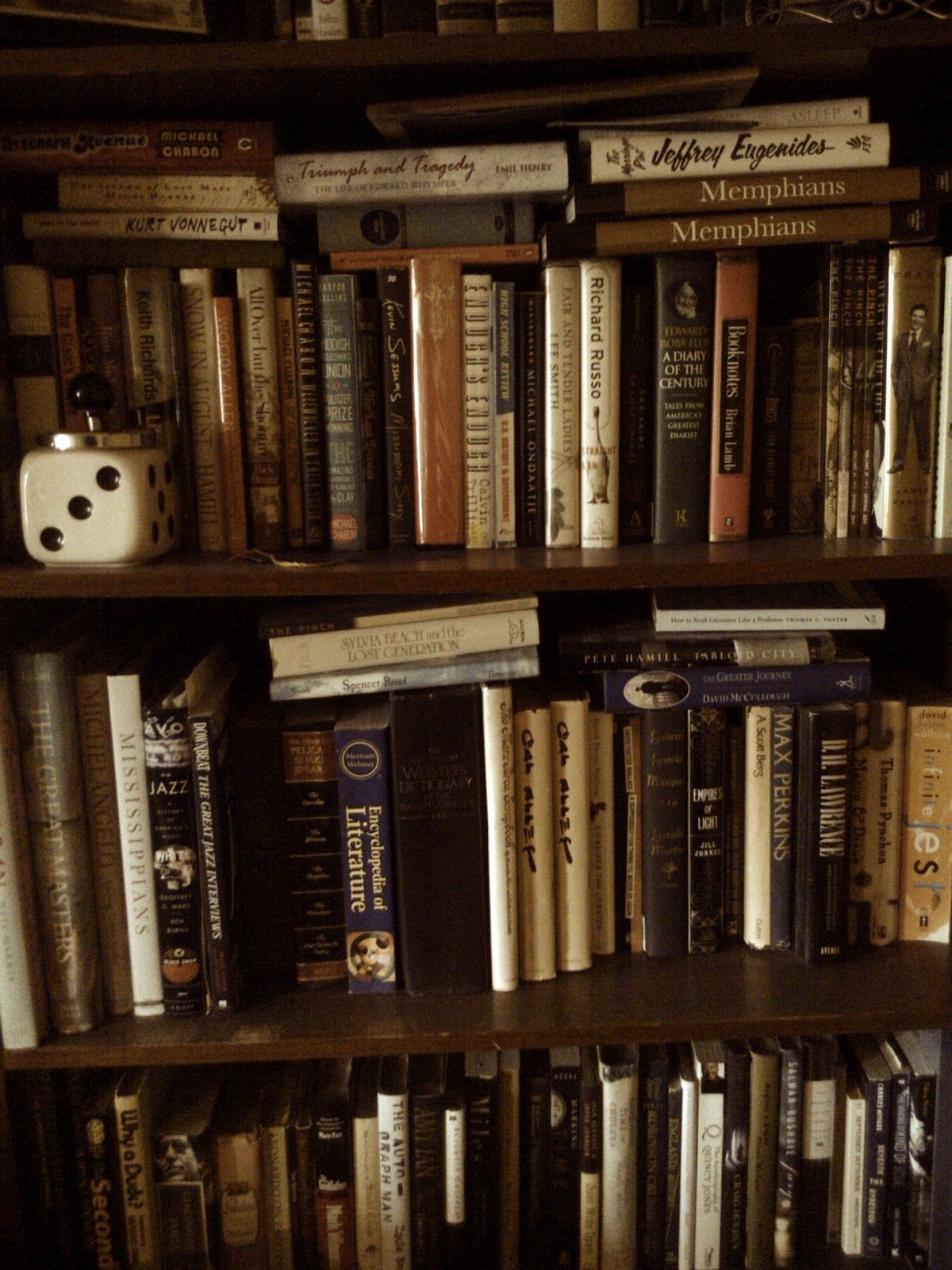
I’m not a writer with a set time of day to work on fiction. I’m more comfortable letting the mood strike me and putting down what I want to say, though I do try to touch on it each day, whether it’s writing a new piece or revising something previously written. A lazy writer, the mood does nevertheless tend to strike me at the same time each day, in the late afternoons and early evenings. It’s not an ideal time for someone with a house full of people, dinner to tend to, laundry, dishes, homework and bedtimes. I should be more disciplined, perhaps, I should set my clock for sometime deep in the a.m. or burn the midnight oil well into a new chapter. I have friends who write each day at the same time and I envy them their discipline. I’ve done this before, but only when I’m near the end of a project and want to push through, when the light at the end of the tunnel flutters my eyelids and wakens me before the alarm clock.

I’ve read that Michael Chabon, if he’s near the end of a novel, or on a particularly difficult portion of whatever he’s working on, will say goodbye to his wife and four kids for a stay in a hotel where solitude and peaceful working conditions help him realize his goal. I can’t imagine even suggesting such a thing in my home. Then again, I don’t have a Pulitzer, or any bestsellers, (or a published novel) to back me up. Chabon’s latest, Telegraph Avenue (Harper, 2012), is more evidence for why the man should have his own suite at the Chateau Marmont.

The book is the story of Nat Jaffe and Archy Stallings, longtime friends who are struggling to keep their record store, Brokeland Records – a haven for the denizens of Telegraph Avenue, for the hip, the has-beens and the policy makers of pop culture – open in the glare of a corporate megastore, Dogpile, threatening to take up residence in the neighborhood. Their wives, Gwen Shanks and Aviva Roth-Jaffe, are partners in a midwifery practice and face their own struggles for acceptance in a world of ever-increasing medical convention. Archy’s estranged father, Luther Stallings, a one-time kung fu champion and blaxploitation film star, is a source of concern for his son like a migraine sneaking up from the back of the skull. And there are so many more, a whole, colorful cast of characters carrying the backbeat of plot like Parliament Funkadelic or the MGs.

In Telegraph Avenue, I imagine Chabon takes to heart the old adage “Write what you know.” Maybe he did a lot of research for his story based in Berkeley and Oakland, and the worlds of vinyl soul albums, 1970s film noir, leisure suits and all manner of vintage and pop culture from the late 60s and 70s. But maybe, when he had a question, he simply walked across his office to a wall-length bookshelf and took down a comic book or album to peruse, read, listen to and study. He loves this world he inhabits and wants nothing more than to give us a tour with a soundtrack provided by his very own mix-tape.

All Chabon books will forever be compared to The Amazing Adventures of Kavalier &Clay (Picador, 2000), which is unfair, but it is a book I carry with me; not physically, though I probably could the way Nate Jaffe’s son, Julius, carries his portable, plastic eight-track player, but inside me where it hums just as Nat keeps a constant beat in his head. It is a book that astounded me the first and second time I read it. The characters of Joe Kavalier and Sam Clay live in a real world swirled within the magic and fantasy that their dreams, fears, relationships, and lives are hinged upon. Telegraph Avenue isn’t so different, though the nostalgia – and there is nostalgia, to be sure, try not to overdose on it – takes us back, not to pre-World War II Prague, but to post-Vietnam San Francisco, and into the bedrooms of every 14-year-old boy ever, replete with the sloppy experimentation in music, sex, pop culture, and the independence they all precipitate.

There are small, insignificant issues I have with a storyline or two, but I’m willing to let those go because of the writing. There is nothing quite like a Chabon sentence. It’s like a steak dinner or a chocolate cake dessert, not just a slice, either, but the whole damn thing eaten in one sitting, with some ice cream on the side, and maybe a glass of ice cold milk.

Regarding writing sentences, Chabon told NPR’s Fresh Air:
“Sentences are the purest, simplest, most pleasurable part of writing for me. And it's the part that comes the easiest to me. … I love that aspect of it: the shaping of sentences, the crafting of sentences, that's the fun part of writing for me.”
And it shows. He packs so much into one sentence that I tend to read a page or two and then back off, lean back on the sofa, loosen my belt and digest it all. There is, of course, Part III, “A Bird of Wide Experience,” with its single, 12-page sentence, but that’s just showing off and, frankly, unnecessary. It’s more a testament to Chabon’s standing in the publishing world, and an overeager editor, than his writing ability. Can you imagine an unknown author including that bit in a query letter to an agent? “Oh, and in the middle I include one single sentence that goes on for a dozen pages. People will love that.” The rejection letter would be much more brief and written immediately after reading that queried sentence.

But that’s nitpicking because the writing is beautiful, all of it, every adjective (plenty), comma (many), clause, phrase, digression and aside. Chabon hooks his words together like train cars to take us on a journey through descriptive lands peopled with fanciful citizens, all dressed to the nines in their flamboyant Aztec numbers, and all strutting to their own brand of funk.