Showing posts with label politics. Show all posts

Monday, September 10, 2012

Hidden Memphis: Lloyd T. Binford


For almost two years, every other month, I've written the series "Hidden Memphis" for The Commercial Appeal. It's a lot of work, which is probably why it hasn't become a monthly series. Coming up with story ideas, researching them, locating experts or descendants or anyone who might have a connection to a 60-year-old building or industry or individual takes a lot of time and research. Looking at it as a freelance writer, it probably takes too much time when you get down to dollars per hour. But I love it. I love learning about little-known characters and finding images from our city's prodigious, notorious, colorful, shameful, hopeful, ill and progressive past, and sharing what I learn with others. And, to be truthful, the amount of time spent on any one story is probably, in large part, my own fault. When I get into the Memphis & Shelby County Room at the Benjamin L. Hooks Central Library and the helpful librarian brings me a stack (it's always a stack, if not a truckload) of newspaper clippings, scholarly papers, letters, photos or marginalia from early last century, I just can't help but read through it all. And when Wayne Dowdy, resident historian and manager of the room, happens by, I can't help but pick his own gray matter file for information and perspective.

Such was the case with the story that ran in yesterday's paper on Lloyd Tilgham Binford, the chairman of the Memphis Censor Board from 1928 until just before his death in 1956. I'd heard bits and pieces, anecdotes, about Binford over the years as I researched Film Row or the long-gone movie theaters of the past, but he was never a major subject in either of those stories so I just filed his name away for later. When my editor suggested Binford for a "Hidden Memphis" topic, I somewhat reluctantly agreed. It seemed to me that everyone already knew about him, how hidden could he be? And how much information could there possibly be on one man who wasn't a mayor or civil rights leader in this town? So I put out a call to all of the usual suspects, and some unusual suspects, that I look up for such stories, packed up my legal pad and pencils and headed to the Memphis Room. And, of course, they had everything I might need: pages and pages of stories and obituaries on Binford. He was quite notorious in his day, and quite often quoted. Perfect.

I pieced a story together through the voluminous wordage published on the commissioner, and talked with his great-granddaughter, Tamara Trexler, and grandson, Fred Trexler. I picked the brains of movie house historian Vincent Astor, University of Memphis professor Danny Linton, film directors Willy Bearden and Craig Brewer, film commissioner Linn Sitler, Malco magnates Michael Lightman and Nancy Tashie, Google and Dowdy. I sent the story in and, as I am wont to do, spent the rest of the week rewriting it in my head. The only problem with newspaper writing, I've found, is the limited space available; this story could have easily been twice as long.

I wanted to be fair to Binford, although being fair to someone when all evidence points to the fact that he banned films from the viewing public for racial reasons, or kept adults from seeing movies he felt to be too racy, both in image and language, is difficult to do. Government censorship doesn't deserve a fair shake. But Binford's background is interesting – a self-made businessman who grew his company from nothing, built an iconic home office that is a treasure in downtown Memphis today, and all with little more than a grade-school education. He also headed the Mid-South Fair from 1928-1931, and gave more than $10,000 to farm youth organizations. He was active in politics and acted as campaign manager for E.H. Crump. He was vice president of the Memphis Chamber of Commerce, a member of the board of trustees of the National Council and YMCA, on the board of Baptist Hospital; he was a Mason, Shriner and an Elk. And, according to newspaper accounts and Tamara Trexler, because of his charitable works here and in his hometown of Duck Hill, MS, there were over a hundred children throughout the south who had been named for him.

But then again, he banned movies from being seen because they deal " ... with social equality between whites and negroes in a way that is not practiced in the South." And in an attempt, seemingly, to reclaim - or dispute - his reputation, he was quoted in the Memphis Press-Scimitar on Sept. 26, 1947: " ... I'm one of the few white men in Memphis that got a six-pound fruit cake from negro friends last Christmas. I also received 18 Christmas cards from colored folks – and sent out the same number."

Does that help or hurt his case? Wayne Dowdy and I had discussions theorizing that Binford banned all-white or mixed-race audiences from seeing all-black or mixed-race casts for fear that the white audience members would riot and not for any danger from the black viewers. I looked for any evidence of this, for Binford simply mentioning it in one of the copious interviews he said he disliked to do, yet gave at the drop of a hat, apparently. I couldn't find anything concrete, so it remains a theory.

Regardless, it's the perceived fairness held in his own mind that makes Binford a complex and fascinating person; a real-life movie character himself who was, perhaps, stranger than fiction. The very fact that Memphis had a Board of Censors is strange enough until you place it in context, in a time when blacks and whites couldn't use the same water fountain or bathroom, when people were openly discriminated and physically assaulted for their beliefs. Strange times, indeed, and worthy of study so that they are never, ever repeated.

Banned or 'Binfordized

"Brazen." "Rowdy … unlawful … raw." "Salacious and risqué."

All adjectives that might be used to sell a movie to today's viewing audiences. You can just imagine such adjectives in big, bold letters plastered beneath the title or across the screen of a coming attraction. From 1928 until 1956, however, these were scathing words used by Lloyd Tilgham Binford as he edited films or banned them outright from being shown in Memphis.

Recently retired from the company he founded, Columbian Mutual Life Insurance Co., Binford wasn't looking for work in 1928 when he was appointed chairman of the Memphis Board of Censors. He awoke one morning to learn from the newspaper that he'd received the appointment from newly elected Mayor Watkins Overton. Binford accepted the position on a temporary basis for only 90 days "as a favor to the mayor," his obituary reads.

It was a title he would hold for 28 years, retiring at age 88 in 1956.

Born in Duck Hill, Miss., where he would eventually have a high school named after him, Binford had a simple, religious upbringing that would one day help to inform his decisions when it came to film censorship. He quit school at 16 and went to work as a railway mail clerk for the Illinois Central Railroad. As a clerk, his train was once held up by the famous train bandit Rube Burrow; as a film censor, he would outlaw films depicting train robberies and the like, including "The Outlaw," the serial "Jesse James Rides Again" and "Destry Rides Again." Though opposed to violence of any sort in films, he did allow that "if we stopped every movie with a murder in it, there wouldn't be any left."

Lloyd T. Binford
He went to work for various insurance companies, eventually starting his own in 1917. That company was moved over the course of a weekend from Atlanta to Memphis, where Binford would build a new headquarters, an iconic monument on the Downtown skyline, the Columbian Mutual Tower on the northern edge of Court Square. It was one of the first skyscrapers in Memphis; Binford ran his insurance and censorship empires from a top-floor office. The building would be sold years later and renamed the Lincoln American Tower, but the visages of Binford's children can still be found carved into the building's facade.

A millionaire when he retired from insurance, he accepted the chairman position for $200 a month. As a civil servant, he upheld the standards of the state, the city and the Hays Code, a set of guidelines used to govern studio film releases from 1930 to 1968, and named for Will Hays, a Presbyterian elder enlisted by Hollywood to improve the image of its studios. The Hays Code, also known as the Motion Picture Production Code, was used until 1968 when the Motion Picture Association of America adopted the rating code in use today.

As chairman of the Memphis Censor Board, Binford enjoyed free rein to edit films — known as having been "Binfordized" by Hollywood — or ban them outright. A moral gyroscope in the Crump political machine, he passed judgment on pictures that were "immoral or inimical to public safety, health, morals or welfare."

"The Little Tramp" did not pass muster with Binford. All Charlie Chaplin films were banned from Memphis theaters, Binford telling The Associated Press upon banning "Monsieur Verdoux" in 1947 that "we don't have to give our reasons" before adding that "(the film is) a comedy that makes murder a joke."

But the reasons weren't always found within the frame of a particular film; the character of the actor or actress mattered to Binford as well. He thought Chaplin a "London guttersnipe" and expounded to the Memphis Press-Scimitar in 1952 that "America has been good to Chaplin and has made him rich, but he has not been a good American … (Chaplin) is a traitor to the Christian American way of life, an enemy of decency, virtue and godliness in all its forms, a reputed endorser of the Communist Party."

Ingrid Bergman fell into his cross hairs as well with 1950s "Stromboli" being banned from cinemas. "It would be inimical to the public morals and welfare to permit the public exhibition of a motion picture starring a woman who is universally known to be living in open and notorious adultery," Binford told The Commercial Appeal in February of that year. Bergman was having a public affair with the film's director, and married man, Roberto Rossellini, at the time.

Binford's reach and notoriety stretched as far as Hollywood and New York, and screenwriters would send him scripts and scenarios ahead of time to get his approval and keep their product from being "Binfordized" after the fact.

In an era when movie theaters were segregated between the races with balconies reserved for African-Americans, if at all, or special days when they could attend movies, Binford sought to ban those movies with all-black or mixed race casts. Famously, Binford banned Hal Roach's "Curley" — a re-imagining of his "Our Gang" series — in 1947 for depicting white and black children in school together. United Artists would appeal and the case would ultimately make it to the Tennessee Supreme Court which, in 1949, stated that "the Memphis Board of Censors has no authority to disapprove a picture because there are Negro actors appearing in it."

"We'll just have to pass these pictures," Binford told The Commercial Appeal, though that same year he banned "Lost Boundaries," stating, "It deals with social equality between whites and Negroes in a way that is not practiced in the South. We banned it for that reason."

These are reasons that Binford's great-granddaughter, Tamara Trexler, wishes had not been. A film producer herself ("Charlie's War,"2003; "Dear Mr. Cash," 2005), she also was the Nashville Film Commissioner from 2000 to 2002, and would begin speeches in that capacity with anecdotes of her notorious ancestor. Her great-grandfather was an intelligent man who, though he left school as a teenager, wrote several volumes of his own encyclopedia with information on science, philosophy, religion and politics. And though she might agree with his notion that there is too much violence in films, on the racial issue, she says "that hurts that he did that."

Binford married Hattie Nelson of Memphis in 1895, and the couple had four children listed in his obituary as Mrs. Tom Thrash, Mrs. Fred Trexler, Mrs. Elizabeth Moon and Lloyd T. Binford Jr. Hattie died in 1927, and he married Jennie May McCallum in 1937, living at 1723 Peabody.

Trexler's father, Fred Trexler, is a Southern Baptist minister who recalls visiting Binford in his Midtown home. He remembers his grandfather as "very much an individualist with a very strong personality, that's why he did what he did." More exciting than those home visits, though, were the perks that went along with being Binford's grandson. "My mother and I would be invited on occasion to the Paramount where he previewed his movies."

Though movies might be banned from local theaters, it didn't mean they escaped the eyes of film buffs completely. "His iron thumb saw plenty of movies miss the Memphis market altogether," said Daniel Linton, a professor with the Communications Department at the University of Memphis. "Some of the 'scandalous' movies he banned were screened in West Memphis instead, and so a little booming film market was created in a place that doesn't even have a theater these days."

"It was the Joy Theatre in West Memphis, so I've been told, that showed the movies he wouldn't let play in Memphis," said local movie theater historian Vincent Astor. "It made lots of money."

Linton says: "Many major cities had similar boards, though they weren't always known as 'censor boards' per se ... This all sounds like ancient history, but actually the last one finally disbanded in Dallas in 1993."

Binford died on Aug. 27, 1956, and is buried in Elmwood Cemetery. His legacy lives on in a city that has struggled with issues of equality and acceptance, and has, in recent years, seen a burgeoning film community take shape. From 1928 until 1956, however, Binford always had the last word on the town's big-screen culture.

"I have no regrets about the movies I've banned," he told the Press-Scimitar in 1947. "Take 'Duel in the Sun.' It was unquestionably the dirtiest movie I've ever seen. And I can't say anything too bad about that Charlie Chaplin."

Some Films or Stage Productions Banned or ‘Binfordized’

“Rope” (1948): Directed by Alfred Hitchcock; “brazen and immoral … revolting and repulsive.”

“Annie Get Your Gun” (1947): A Broadway stage musical with a mixed-race cast; the show “is not being allowed to play anywhere in the South, except Texas, and whatever those folks in Texas do doesn’t surprise me.” In addition to the cast’s ethnicity, “the musical score is suggestive, salacious and risqué.”

“Bamboo Prison” (1955): “Unpatriotic”; was to be exhibited by Malco, decision to ban later reversed after suit brought by Columbia Pictures.

“Forever Amber” (1947): “Entirely filthy.”

“Stromboli” (1950): On star Ingrid Bergman: “It would be inimical to the public morals and welfare to permit the public exhibition of a motion picture starring a woman who is universally known to be living in open and notorious adultery.”

“Lost Boundaries” (1949): “It deals with social equality between whites and Negroes in a way that is not practiced in the South.”

“The Wild One” (1954): “That was the worst, the most lawless bunch I ever saw and the most lawless picture I ever saw. There was nothing immoral in it, it was just rowdy and unlawful and raw.”

“French Line” (1954): Binford called police to keep the uninvited from entering a private preview of the movie at Malco Theatre.

“Miss Sadie Thompson” (1953): Banned for a dancing scene by Rita Hayworth; “The whole picture is a travesty on religion and everything in it is raw.”

“Tragic Ground” (1953): Play banned in Memphis that played at the Plantation Inn in West Memphis.

“Monsieur Verdoux” (1947): “a comedy that makes murder a joke.”

“A Song is Born” (1948): “inimical to the public welfare”; cast includes a “rough, rowdy bunch of musicians of both colors … there is no segregation”; “The musicians are raising the dickens … Jazz and the blues were actually born in Memphis anyway, down on Beale Street. There is too much French in New Orleans for jazz. It’s a rough, bawdy, noisy picture dealing with band musicians, in general a mixed-up jamboree.”

“Wedding Rings” (1930): “… the absolute violation of the sanctity of marital relationships …”; Shown at the Orpheum with a stretch of film bearing only the words “Cut out by board of censors.”

Others, banned unless otherwise stipulated:
“The Southerner”
“Brewster’s Millions”
“The Outlaw”
“Duel in the Sun”
“Jesse James Rides Again” (serial)
“Destry Rides Again”
“Jesse James”
“The Return of Frank James”
“The Daltons Ride Again”
“The Macomber Affair” (Hemingway novel, banned until deletions were made)
“Pursued” (censored)

HIDDEN MEMPHIS
This occasional series profiles people, places and things, past or present, that are quintessentially Memphis. Do you have an idea for someone or something for this series? E-mail Richard Alley at richard@richardalley.com.

© 2012 Memphis Commercial Appeal. All rights reserved. This material may not be published, broadcast, rewritten or redistributed.




Tuesday, November 08, 2011

Memphians


Earlier this year I had the privilege of being asked to contribute to a new book about some of the well-known, and lesser-known, personalities in our city. The book is called Memphians (Nautilus Publishing) and it is being launched this Thursday at Burke's Book Store.

It's a big, beautiful book at almost 250-pages with large photos and bios written on folks such as Shelby Foote, Isaac Hayes, Charlie Vergos, Clarence Saunders, Charles McVean, Jim Dickinson, Justin Timberlake, Furry Lewis and many, many more. There are those you'd expect to be in here, and some you might not have.

It was a lot of fun researching and writing these pieces, and fun working with the other writers and editors - Dan Conaway, David Tankersley, Dennis Phillippi, Richard Murff and Neil White. I hope you'll come out and join us all this Thursday at Burke's. We'll be there, as will a whole lot of other Memphians.

Thursday, November 10
5:30 p.m.
Burke's Book Store
936 South Cooper St. 
(in the heart of Cooper-Young)


Monday, October 17, 2011

To Great Lengths

Before I went to interview Emil Henry for yesterday's story in The Commercial Appeal (Writing mountaineer bio a career pinnacle, Oct. 17, 2011), I was given detailed instructions for how to get to his house inside the gated community within Chickasaw Gardens. E-mailed instructions that included the suggestion I bring my cell phone along just in case something comes up.

And something did come up! The power was out in the whole subdivision, so the electric gate didn't work. Someone standing on the other side of that gate sent me around to the south side of the community where there is an emergency gate used by the fire department, service vehicles, etc. At that gate there was a line of cars waiting to get out, we were all waiting on the security guard to come let us out and in. When he showed up, he had trouble manually opening the large, iron gate by himself, so I jumped out and gave him a hand.

It's arduous, sometimes, what we go through to get a story. Take Emil Henry, for instance. He scaled the Matterhorn in the Swiss Alps in 1984 at the age of 55. When I asked him about it, his answer reminded me of George Costanza telling that woman that he built the addition on the Guggenheim: "Didn't take very long, either."

Was it difficult? I asked Mr. Henry. "No, not really," he replied. Seems they have ropes attached to the summit to help a climber pull him or herself up the rest of the way. That's helpful. It took him nine hours total, from bottom to top and back down - a regular work day without a proper lunch is all. He was quick to say, however, that 431 people have perished trying to scale that summit.

The story was in the writing of the book about the first man ever to scale the Matterhorn, Edward Whymper. Henry traveled to Switzerland, France, Italy and England for the facts; all on his own time, all on his own dime. I don't write nonfiction, other than these pieces for the newspapers and magazines, but there is something appealing about traveling halfway around the world for an in-depth story. It's work, certainly, but what an adventure.

Speaking of work, Henry was the chairman of the FCC for a bit, appointed at the age of 34 by John Kennedy in 1962. There are stories about that that had no place in the newspaper story about his book. For instance, when he first traveled to Geneva as an FCC representative, it was for a conference on radio frequencies to be used in space. Moscow and Washington were in a race to the moon and it needed to be determined who would use which frequencies up there. Isn't that civil?

And, as chairman of the FCC, Henry was the last official visitor to the White House before Kennedy was assassinated. He was in the Oval Office escorting a dignitary from England or some place, immediately after which JFK and Jackie left for New Orleans and then Dallas the following day. Henry was having lunch with his English counterpart when the Brit was called to the phone, returning to inform Henry that his president had just been killed.

Incidentally, the last unofficial visitor to the White House was Nat King Cole, who Henry saw there taking photos with JFK as he left.

There are stories everywhere! Stories on mountaintops, stories locked behind dead gates in Chickasaw Gardens and stories that might be realized in the following days with a phone call or a communiqué over an as-yet determined radio frequency.


Writing mountaineer bio a career pinnacle

To hear Emil Henry tell it, climbing the Matterhorn at 55 years old wasn't so difficult. There was little training, only to be tested on skills, endurance and altitude sickness; it wasn't even a life's dream.

"As tall, high mountains go, it's probably the easiest of all the high mountains in the Alps now," Henry said of the summit that has seen 431 deaths, 58 in the 21st century alone.

Researching and writing a biography of Edward Whymper, the first person ever to scale the 14,690-foot mountain, however, became a monumental task of endurance, travel and expense. And a challenge he wouldn't give up for anything.

"It turned out to be the most enjoyable occupation of my life," Henry said of the book, "Triumph and Tragedy: The Life of Edward Whymper" ($18.31).

Henry, now 82 with three children and five grandchildren, began life in Memphis, growing up in Chickasaw Gardens before going away to a boarding high school in Pennsylvania and college at Yale. He joined the Navy during the Korean War, spending three years on a destroyer in the Pacific Ocean, and then went to Vanderbilt for law school.

After practicing law in Memphis for five years, he was appointed to the Federal Communications Commission in 1962. When the chairman resigned only eight months later, Henry was appointed, "at the ripe old age of 34," chairman of the FCC by President John F. Kennedy.

It was in 1963, while in Geneva for a conference as the FCC representative, that Henry was first approached with the idea of climbing the Matterhorn. "I don't do that," he said. "It's not my thing." He reconsidered 21 years later when a business colleague suggested he contact mountain guide Rickie Andenmatten.

"My guide (Andenmatten) said, 'Emilio, you're going to get waked up at 4 o'clock, get dressed, eat a light breakfast, we're going to walk out the door at 4:30 and it's action, action, action'," Henry said. "We got to the top of the Matterhorn at 9:30."

It took five hours to scale the mountain and four hours to descend, Henry said. "My legs were jelly."
The Matterhorn is part of the Swiss Alps and sits on the border of Italy and Switzerland. With its iconic summit and difficulty to conquer, it was known during the Golden Age of Mountaineering (1854-1865) as the "impossible mountain."

Edward Whymper was a young Englishman -- only 25 at the time he became the first to scale the Matterhorn in 1865 -- who would also become an accomplished author, artist, photographer, lecturer and natural scientist who researched the causes of altitude sickness. "He was many things, and this book is about all of those things."

It was the discovery in a Zermatt bookstore of Whymper's own book, "Scrambles Amongst the Alps," first published in 1871 and still in print in an abridged version in 1984, that led to Henry's fascination with the adventurer. Whymper wrote several other books, but the only full biography on the man was one published in 1940. "It was highly dated and highly opinionated, and it did not give a full picture of the man, in my opinion," Henry said.

So Henry set about to write a comprehensive book about not only Whymper, but also the circumstances surrounding the Golden Age of Mountaineering, the physical challenges, triumphs and tragedies, and the majestic mountains themselves. "Part of the allure of this book was due to the romantic appeal of the Alps themselves and the Alpine regions," he said. "Chapter 3 is only about the Alps, how they were formed in geological time, what they look like, how they differ from the Himalayas, the spirited amateurs who climbed them, the chalets and haylofts where the climbers found shelter. I compare the early mountaineers to the aviation pioneers."

The writing was an expedition in itself, taking Henry to England, Wales, Switzerland, France and Italy. "I wanted to do justice to the man, I wanted it to be a serious biography ... so I spent a lot of time at the Alpine Club Library in London."

It was all research paid for out of his own pocket, he said, adding, "I'm not in it for the money." There were several publishing houses and agents interested in the manuscript, including several in the United States and Random House in London. "I finally decided that companies and agents were not going to publish an octogenarian, unpublished lawyer." He ultimately self-published the 428-page book through Troubador Publishing in the UK, where Whymper is vastly better known.

The book is for sale through all online retailers, as an e-book and at the Booksellers of Laurelwood, where Henry recently held a reading and book signing.

The Golden Age of Mountaineering ended with Whymper's ascent of the Matterhorn in 1865, not because he proved the "impossible mountain" could be conquered, but quite the opposite. On the descent, four members of his team plummeted thousands of feet to their deaths, the worst tragedy in mountain climbing history. The sport has changed over the years with improved technology and a better understanding of the conditions the human body can withstand.

But what haven't changed are the public's fascination with the environment and man's need to push himself and challenge the unknown within. In his book, Henry explores the life of a true adventurer and a theme which helped Henry push himself to the summit.

"What I tried to do and what I've done, I think, is to create the story of this man's life and, in so doing, illuminate as best I can his character and the things that set him aside from other people," Henry said. "So it's not just about mountaineering, but mountaineering ... goes a long way in explaining the kind of man he was."

© 2011 Memphis Commercial Appeal. All rights reserved. This material may not be published, broadcast, rewritten or redistributed.


Monday, October 10, 2011

A Brief History of the Park System of Memphis

For the current installment of the semi-regular Hidden Memphis series for The Commercial Appeal (Park place: Establishing recreation system was linchpin of improving Memphis; Oct. 9, 2011), I jumped feet first into the history of the Memphis park system. The subject was a last-minute replacement when a person I wanted to write about proved to be impossible to contact. My editor asked what else I had and I impulsively suggested parks.

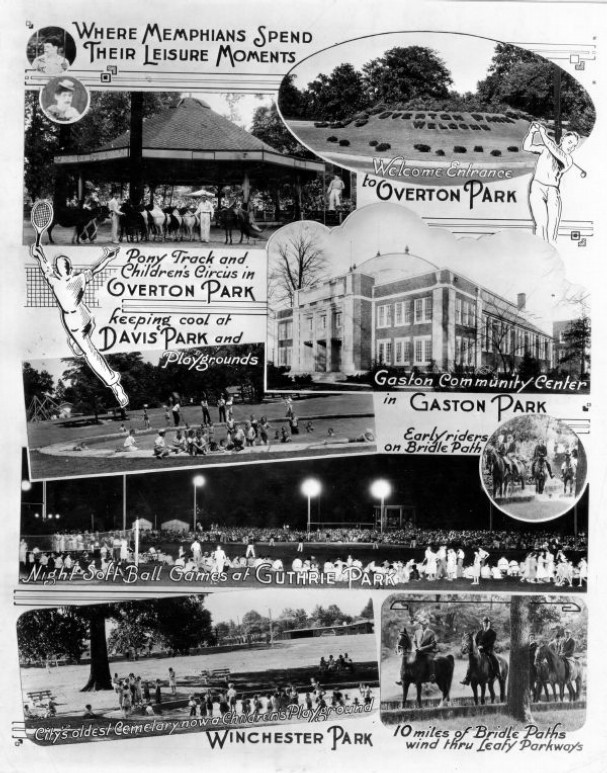
Promotional poster for the
Memphis parks system

It seemed simple, as I always think these stories will be, and then I went to the Memphis & Shelby County Room at the main library, asked Sarah F. for whatever they had on the park system and was inundated with files upon files of clippings, books and a listing of further collections. This is good, this is better by far than not having enough information.

The stories in this series take a lot of time and energy. There are usually copious newspaper clippings to go through, people to find and interview, and, often times, site visits. The story on the parks proved no different. Despite the effort it takes, and the disproportionate pay for work done, I really do get into the subjects and I feel that they're important for Memphians to know. Understanding why the city is structured the way it is, or who made it so, is part of what being a local is all about; it's this understanding that instills pride and gives us all a sense of place.

One interesting piece that had to be cut from the story was about the underground sewer system implemented here in the 1880s:
Memphis’s determination was made all the more evident as she was beautified from the underground up. Colonel George W. Waring Jr. of Rhode Island suggested, at a special meeting in Nashville in 1879, an underground system of separating sewer water and storm water. The idea was implemented immediately by Mayor D.T. Porter.
“This sewer design, known as the Waring plan in Memphis, became known as the Memphis plan in the rest of the world as city officials from afar came to see it,” writes Paul R. Coppock in his book “Memphis Sketches.” 
As usual, I had plenty of help on this story, from Sarah to Wayne Dowdy who helped find great old photos of parks and the parkways, the vast knowledge of the city in Jimmy Ogle's encyclopedic mind, and the wonderfully detailed writings of Perre Magness. Thanks to all of them.

If you have an idea for a story in the Hidden Memphis series, please send me an e-mail at richard@richardalley.com.

The story:

The founders had a plan, and it began with the parks.

When Memphis was established in 1819, parks and open spaces were as much a part of the vision as the Mississippi River, commerce and cotton. With a total of 36 acres decreed by the founders (the earliest being Court Square, Market Square, Exchange Square, Auction Square and the promenade along the bluff), Memphis established itself as a city on the cutting edge of culture, recreation and meeting the needs of the community.

Today, with activists and leaders suddenly intent on expanding and utilizing existing green space as an amenity to attract a creative class of people and industry, it's a resource the city has actually been cultivating and sitting upon since its earliest days.


As early as 1889, Judge L.B. McFarland began looking into the creation of a park system for the city. Nine years later, John C. Olmsted, son of Frederick Law Olmsted Sr., the designer of New York's Central Park, visited Memphis to investigate the possibility of such a system.

The mood of the nation following the Civil War, Reconstruction and the yellow fever epidemics led to an avid progressive movement of city beautification.

The leaders of the day "rallied around the idea that the city could be rebuilt to the highest standard of quality and innovation, and, as an example, the city beautiful movement advanced those ideas in parks, open space and with the parkway element, not just as a scenic drive but as a way to create and improve the form of cities where they could be organized around beautiful, linear parkways that would also enhance development and real estate values," said Ritchie Smith, a landscape architect who drew up the 1988 Overton Park Master Plan.

Today, in the Memphis Park Services building on Avery (on land acquired by the Park Commission through a delinquent-tax seizure in 1936), the minutes of meetings for an infant commission are recorded in large, crumbling leather-bound books. With the flourish of a neatly written hand that allows us into the paneled offices of men who dreamed of the outdoors, the Memphis Park Commission was established in 1900. Ever since, it, and its subsequent entity known as Memphis Park Services, has maintained a patchwork quilt of turf, trees, pools, recreation centers and ponds.

Also recorded in the books is the commission's interest in land found "in the northeastern portion of the city," the 347-acre Lea Woods. It was soon purchased for $110,807 from Overton Lea, grandson of city founder John Overton. The park was called East Park before eventually being renamed to honor Overton.

City planner and landscape architect George Kessler of Kansas City, Mo., was hired in November 1901, and he drew up plans for a system of scenic parkways to connect the new Overton Park with Riverside Park in Downtown.

During his career, Kessler planned hundreds of projects internationally and across the country, including Dallas, Cleveland, Indianapolis, El Paso and the grounds for the 1904 Louisiana Purchase Exposition in St. Louis.

Riverside's 379 acres had been used for emergency burials during the yellow fever epidemic and, later, to grow hay and vegetables that would be used to feed animals at the new zoo in Overton Park.

In 1913, a golf course was added to Riverside. A dam was constructed in 1952 to divert the river to the other side of Presidents Island, forming McKellar Lake with a marina built by the Park Commission. The park was renamed to honor Dr. Martin Luther King Jr. after his assassination.

Kessler, realizing that the open spaces were public and paid for by citizens, designed with an eye toward easy and ample access, even though there were only a handful of cars in Memphis at the time.

"In 1904, there were eight; in 1910, there were 1,000, and the speed limit was 8 mph," said historian Jimmy Ogle, who worked for the Memphis Park Commission in several capacities, including deputy director, and now offers a walking tour of Overton Park.

When thinking of parks, images of children playing, ducks and geese on ponds, picnics and sports fields spring to mind. The system of North, East and South parkways, however, is a shady, flowering trail designed and still maintained by Park Services. The system was added to the National Register of Historic Places in 1989.

"They still are the best roadways that we have developed, and it has been 100 years," Ogle said. "Three lanes, park-like median, dedicated turn lanes, very few traffic lights." Last month, the city began restriping North Parkway for dedicated bike lanes to connect Overton Park with Downtown.

During the first half of the 20th Century alone, we had the additions of Bellevue Park, Morris Park, Lincoln Park, Williamson Park, Treadwell Park and the Pink Palace. In an effort to battle the Southern heat, public pools were opened in Orange Mound, at the Fairgrounds and in North Memphis.

Land encompassing the Indian mounds known as the Jackson Mounds, south of what is now Interstate 55, was purchased in 1912 and renamed DeSoto Park (again renamed Chickasaw Heritage Park in 1995). In 1913, 53 acres north of Chelsea were established as Douglass Park. Both were outside the city limits at the time, and both were designated for black residents only, part of the segregation of city parks that lasted until a Supreme Court decision in 1963 ended such laws.

The second half of the century saw the creation of parks Glenview, Gaisman, Belz, Gooch, E.H. Crump, Martyrs and the Spanish American War Memorial at East Parkway and Central.

During the 1960s and '70s alone, federal money made possible the acquisition of more than 2,500 acres and the creation of 50 parks.

Two parcels of land totaling 355 acres were purchased just outside the city limits at the time for more than $400,000. Former mayor Crump, a bird enthusiast, lobbied for the name Bluebird, but the Commission fancied Audubon. There was already a small park on Central near the Fairgrounds named Audubon, however, but the Commission took the name for the new park and renamed the old one Tobey, now home to baseball fields, a rugby field, volleyball pit, dog park and, soon, a new skate park.

The Ketchum Memorial Iris Garden was planted with 2,500 rhizomes from the garden of Morgan Ketchum, the municipal rose garden was relocated from Overton Park, the Memphis Area Wildflower Society created a sanctuary for displaced native plants, and, in 1964, the family of retailer Jacob Goldsmith dedicated the public gardens. It was renamed Memphis Botanic Garden two years later.

Audubon Park today contains the gardens, an 18-hole golf course, tennis courts and a 6-acre fishing lake. Once outside the city, it has become an oasis within, nestled among railroad tracks, a shopping mall, the University of Memphis and heavily trafficked streets on all sides.

It is this sort of oasis that McFarland and Kessler envisioned more than a century ago. It's a system that has been cared for and attended to by its keepers and citizens alike, though it has come under assault at times by eager developers.

Overton Park was nearly bisected in the 1970s by I-40 until a landmark Supreme Court decision averted that near disaster. It is a case looked upon by courts today and still the only point in the country where I-40 is broken.

The Memphis Park Commission was dissolved in 2000 under the Herenton administration and became a division of city government. Today, the Memphis City Council is considering allowing a conservancy -- like the zoo, Botanic Garden and Shelby Farms have done -- to overlook the management, fundraising and any restructuring of Overton Park.

"The Park Commission are assured of the fact that they can accomplish but little unless supported by a strong, favorable public sentiment," Chairman McFarland wrote. "The people must encourage and help the Commission and the administration in this work if they want a beautiful city."

© 2011 Memphis Commercial Appeal. All rights reserved. This material may not be published, broadcast, rewritten or redistributed.


West entrance to Overton Park; McLean & Overton Park; 1914


Wednesday, June 29, 2011

Chapter One of Chapter 16

A while back, Margaret over at Chapter 16 (an online journal dedicated to books and writers, and supported by Humanities Tennessee) asked me to write a story on how the flooding in Memphis had effected the people here. I had to turn her down, even though turning editors down is the last thing I ever want to do, because I knew she needed the piece in a timely manner (the river had crested and we were already in the waning days of water) and I was just too busy with some other larger projects.

She was kind enough to offer another assignment a few weeks ago and I accepted. She asked me to write a feature on Victoria Ford, daughter of former state senator John Ford, and part of the Ford political dynasty, though not of the machine itself.

Victor had recently won a national Scholastic Art & Writing Award for five essays chronicling her young life, and that of her siblings, within this controversial and broken family. The award has been won in the past by the likes of Truman Capote, Sylvia Plath and Joyce Carol Oates.

I spoke with 18-year-old Victoria at length on the phone and found her to be intelligent, funny, optimistic and grateful. If you've seen any of her family members' antics on the local news or read of them in the papers (John Ford is currently in prison for charges of bribery), you know what an amazing leap this is. Her course is set and, if she follows it, she will go far.

See the story here, and below.

“You may not understand this now, but she isn’t coming back. Not tonight. Not tomorrow. Day after that. And no, she hasn’t left anything behind—a sticky note on the refrigerator door or a quick message for the answering machine, her voice a distant echo calling your name and mine. Nothing.”

So begins the award-winning essay “To a Restless Little Brother Calling for Mama in His Sleep,” one of the five essays that last month helped Victoria Ford, eighteen, win a national Scholastic Art and Writing Award—and a $10,000 college scholarship. Past winners of the prestigious award include Sylvia Plath, Joyce Carol Oates, and Truman Capote. For Ford, the awards ceremony, held May 31 in New York City’s Carnegie Hall, was a moment to remember, one that surely marks the beginning of a life of creativity and success.

Victoria’s last name might not be so well known as the literary giants who took home the Scholastic prize years ago, but it already carries a kind of notoriety in her hometown of Memphis. Harold Ford Sr., the first African-American Tennessean elected to Congress since Reconstruction, was her uncle. Harold Ford Jr., now retired from Congress, is her cousin. Other family members have been elected to the city council, the county commission, and the school board in Memphis. Victoria’s father, John Ford, was a state senator for three decades, another cog in the familial political machine.

Among young African Americans growing up in Memphis, Victoria’s story is far from typical. Memphis is a city with higher-than-average rates of poverty, drug use, single-parent homes, and criminal recidivism, but Victoria grew up in a two-story brick home with a mother and father. She attended an above-average city school.

All families have skeletons, however, and all families weather their own storms. The problems of Victoria’s family were played out on television newscasts and above the fold on the front pages of daily newspapers in the state: in 2005, FBI surveillance caught John Ford accepting a bribe which would amount to $55,000 when all was said and done. During Victoria’s childhood, her mother, Tamara Mitchell-Ford, was imprisoned three times on DUI charges. In 2008, when John Ford finally reported to federal prison, Tamara Mitchell-Ford was already in a state penitentiary.

Victoria now lives in Greenville, South Carolina, with her aunt, Megan Mitchell-Hoefer, in a lively home with six other family members and “always something to write about.” She attended the South Carolina Governor’s School for the Arts and Humanities, a school that her fiction teacher, novelist George Singleton, describes as being a lot like “that bad TV show Fame.” Prospective students must interview and audition and present portfolios of creative work, he says, “so it’s hard to get in.”

“She’s very well-rounded and balanced,” says her aunt, Mitchell-Hoefer. “She’s very family-oriented, she’s a homebody.” This, despite an atypical family home. Also atypical is the way Victoria deals with the spotlight, the skeletons. Her essays tell the story from her point of view, from that of her brothers and sister. They are emotional and impart details from within the home and, in some instances, within the very closet where she has struck up a conversation with those bones. She is candid, unapologetic, sad, and hopeful. She misses her father; she worries for her mother.

Tamara Mitchell-Ford was pregnant with Victoria’s brother, called Johnjohn, when she went away to the correctional center for the first time—“her vacation, as she liked to call it,” Victoria recounts in an essay titled “Like Nothing Else In The Known World.” It’s an essay in which she also writes of her brother’s birth and how quickly she, even as a preteen, learned to change diapers and babysit for ever-increasing amounts of time.

“I bounced Johnjohn in my arms before his nap,” she wrote. “He cried, tears running down his cheeks and over his dimples. I learned that he just needed a rhythm. I’d lay him across my stomach, hold his head close to my chest, and pat his butt. Sometimes I sang. Once he fell asleep, I’d be gone with him.” The essay ends with Victoria’s discovery of empty bottles of booze hidden around the house, and with finding her mother in a car left running in the garage.

It’s easy to understand her protectiveness toward the now six-year-old Johnjohn and why she considered putting off college for a year or two to look after him. Advice from her teachers and aunt changed her mind: “I had a long conversation with my teachers at the Governor’s School about it—we’re very close—and my teachers said, ‘It will work out; your brother will have a place to stay; you have to go to college; you have to get an education.’ They were really supportive.”

Mitchell-Hoefer, whom Victoria calls “a hero,” echoed the faculty: of course Johnjohn would stay with her.

This fall Victoria will be part of the first-year class at the University of Pennsylvania. “I was very set on going to a school in North Carolina to stay close to home because I really wanted to be with my little brother,” Victoria said. “When I got into Penn, I thought, ‘I think this is right.’ I need to be someplace that’s big and someplace that has lots of different types of people and different programs that I can immerse myself into.”

Victoria puts a happy face on nothing that happened before she got to South Carolina and the safe confines of her aunt’s home. In “Letter To My Father,” she is probably the most blunt: “I just don’t feel like I know you as much as I want to” and follows it with “rather, the internet knows more about you than your own daughter.” She cites a Wikipedia article and blogs that contain no mention of his children. What comes through in Victoria’s writing is a painfully honest innocence. She loves her family, but she doesn’t ask readers to forgive them, or even understand their shortcomings.

To help the healing, she reads the poets Larry Levis, Matthew Dickman, Langston Hughes, and Walt Whitman, and the fiction of Richard Ford, yet she is still unsure about her career path, undecided as to a college major, though she is certain that writing will be involved. Singleton thinks he sees the future: “She’s won most of her accolades in non-fiction and poetry, but I kind of think she’s a stronger fiction writer. In years to come, I would imagine she would be writing fiction.”

That’s an opinion shared by her aunt, the elementary-school principal who knows promise when she sees it and imparts sound advice for anyone considering a creative vocation: “I think that she’s going to dibble and dabble in other areas, but I think she’s going to come back around to writing. It is something that she is passionate about, she loves it; anything you love, no matter how much money you may make doing it, you’ll always be a happier person when you’re doing what you love.”

Thursday, October 15, 2009

Candy Corn in the Pipeline

GK called out for me this morning when she woke up so I picked her up and carried her to my office. We sat on the couch and she fell back to sleep curled up in my lap while I read. I wish I could have stayed right there the rest of the day, partly because she's very sweet when she's asleep and partly to procrastinate even further on things I need to do.

I have 13 stories in the pipeline, plus That Other Thing, and the pipeline appears to be plugged someplace. I think the blockage is probably me napping in a fetal position because nothing is getting through. The paid writing (and napping) is also why I've been ignoring this blog, I suppose.

So today I have to find a globe and figure out where England is, then go to Cooper-Young to interview some kids from Nottingham, England. I've done five interviews in the past week and haven't written any of them up, so there's that. I was trying to work out lunch with Kristy, but her job is keeping her unconscionably busy lately. I need to nap.

I should vote for mayor today, too. I wrote my column in today's Commercial Appeal about that very thing, so I feel obligated now. I'm not taking GK, though, because she eventually woke up, crawled out of my lap and put on a dress with a shirt over it.

The shirt has a picture of candy corn on it and reads "Sweet." She says it's because candy is sweet, but I think it's because she is.

Monday, January 19, 2009

An Open Letter to The Quartet

President Barack Obama recently wrote an open letter to his daughters for Parade magazine because that is the publication his 10- and 7-year-olds read regularly, so he knew they'd see it there.

I have no idea what kind of president Mr. Obama will be, but he seems to be a pretty good father. I was inspired by his letter and wrote one of my own to my children. Parade magazine declined to publish it, which is fine, as my kids have no idea what that is anyway. For them to see this letter, I'd have to have Homer Simpson read it on air. So, for now, I'll let you read it.

Dear C and JP and S and GK,

I would like to address you at this time as we embark on a new chapter of our nation's history.

I ask you today to think of things larger than yourself. As President Obama recently asked of his own daughters, I encourage you to hitch your wagon to causes greater than the individual. But first I ask you to pick your socks up off the floor and take your dishes to the sink. Wipe up that spill, please.

This isn't The White House. No one here is scurrying around to assure that your taxpayer-funded home is kept pristine.

I hope you children have taken from this last presidential campaign, and recent inauguration, that even you, too, can one day be the President of the United States. Or, at least, a voter.

Until then, however, I am the president of this house, and my vision is clutter-free. There is no spilled milk here, it is a land with no half-eaten Pop-Tarts left on a chair.

And as much as I want you to hitch your wagon of promise to great dreams, I also want you to promise me you will pull that wagon out of the front yard and to the back at the end of the day, because it looks tacky; and also because this is Memphis and someone will surely steal that wagon of hope if it's left out.

In these heady days of change, regardless of your politics, kids, embrace Barack Obama as your new commander in chief, but remember, always, that I am your commander in this house. Now, please, bring me my drink.

Love, Dad